AI marketing agents have moved well past content generation and email scheduling. In 2026, leading platforms coordinate entire campaign workflows, make real-time decisioning across channels, and execute multi-step sequences without human prompting at each stage. For marketing leaders evaluating the next generation of automation, the platform decision carries significant consequences for pipeline velocity, team capacity, and competitive positioning.
This guide evaluates the top AI marketing agents and automation platforms available to US marketers in 2026: what they do, who they are built for, how they are priced, and where the gaps are.
What Are AI Marketing Agents and Why Do They Matter in 2026?
A traditional marketing automation platform follows rules. It triggers an email when a lead hits a score threshold. It routes a contact to a sequence based on form submission. It does exactly what it was programmed to do, and nothing more.
An AI marketing agent operates differently. It perceives context, sets goals, selects tools, and executes across multiple systems to accomplish an outcome. An agent tasked with re-engaging lapsed customers does not simply trigger a pre-built sequence. It analyzes behavioral data, selects the appropriate channel and message type, adapts the content to the individual's history, executes the outreach, evaluates the response, and adjusts the next action based on what happened, all without a human directing each step.
In 2026, three capabilities separate true AI marketing agents from automation platforms with AI branding: autonomous orchestration across channels and systems, adaptive execution that adjusts to real-time signals, and measurable business impact tied to pipeline or revenue outcomes, not just activity metrics.
Organizations deploying genuine marketing agents in 2026 are achieving significantly faster campaign cycles, higher personalization at scale, and marketing team capacity that focuses on strategy and creative rather than workflow management.
How We Evaluated the Leading AI Marketing Agents
Each platform in this guide was assessed across five criteria: level of genuine autonomy (rules-based vs. reasoning-based execution), integration depth with common US marketing and sales stacks, personalization capability at scale, orchestration across multiple channels, and pricing transparency.
CT Labs' perspective on this evaluation weights governance and transparency heavily. Autonomous marketing agents that operate without audit trails, explainable decisioning, or human escalation points introduce compliance and brand risk that many enterprise marketing teams have not accounted for. Platforms that balance autonomous execution with meaningful oversight controls are rated higher for enterprise fit.
Top 10 AI Marketing Agents and Automation Platforms
1. CT Labs

Best for: US enterprise and mid-market teams that need custom AI marketing agents integrated into their specific tech stack with governance built in from day one.
CT Labs builds AI marketing agents tailored to each client's workflows, data sources, and compliance requirements rather than offering a one-size platform. Marketing teams get 30+ prebuilt ROI agents deployable in weeks, with governance, audit trails, and access controls embedded in the architecture rather than added as a separate workstream. The ROI target is defined and scoped before any agent is built, and milestone-based measurement runs throughout the engagement rather than arriving in a final report.
CT Labs' connection to C&T's AI executive search network means deployments are informed by real-time intelligence from the world's top AI-native marketing organizations, not limited to the firm's own case library.
Standout features: Prebuilt marketing agent library; working demo on your specific workflow before commitment; governance-first architecture; $10M–$20M ROI target in 9–12 months.
Pricing: Custom engagement scoped to ROI target.
CT Labs note: The CT Labs model is purpose-built for organizations that need marketing agents integrated into existing enterprise systems, not a standalone SaaS tool.

2. Salesforce Agentforce

Best for: Organizations already running Salesforce Sales Cloud or Service Cloud that want autonomous AI agents layered into existing CRM workflows.
Launched in 2024, Salesforce Agentforce is one of the most mature enterprise-grade agentic AI platforms available in 2026. Marketing agents within Agentforce operate on the Salesforce Data Cloud, giving them access to unified customer data across sales, service, and marketing touchpoints. Agents handle lead qualification, campaign personalization, and follow-up sequencing with genuine multi-step reasoning rather than rule execution.
Standout features: Deep Salesforce Data Cloud integration; cross-cloud agent orchestration; strong governance and compliance controls; Atlas Reasoning Engine for multi-step planning.
Pricing: Approximately $2 per conversation for Agentforce interactions; included in higher-tier Salesforce bundles.
CT Labs note: Agentforce is strongest for organizations with mature Salesforce deployments. Teams without existing Salesforce infrastructure face significant onboarding overhead before agents produce value.
3. HubSpot Breeze AI

Best for: Mid-market marketing teams running HubSpot as their primary CRM and marketing platform.
HubSpot's Breeze AI, rolled out across the HubSpot platform in 2024 and expanded in 2025, includes dedicated AI agents for content creation, social media management, prospecting, and customer data enrichment. Breeze Agents operate within HubSpot's unified platform, meaning they have access to the same contact data, engagement history, and pipeline information that sales and service teams use.
Standout features: Content Agent for multi-format content generation; Social Agent for autonomous social publishing; Prospecting Agent for outbound sequencing; unified CRM data access.
Pricing: Included in HubSpot Marketing Hub Professional ($800/month) and Enterprise ($3,600/month).
CT Labs note: Breeze AI is well-integrated within the HubSpot ecosystem but offers limited customization for organizations with complex enterprise stacks outside HubSpot.
4. Adobe Experience Platform with AI Assistant

Best for: Enterprise marketing teams running Adobe's experience stack and requiring AI-assisted campaign orchestration at scale.
Adobe's AI capabilities, delivered through the Adobe Experience Platform and powered by Adobe Sensei GenAI, provide AI assistance across audience segmentation, content generation, customer journey orchestration, and real-time personalization. The AI Assistant in AEP allows marketers to query data, generate segments, and execute workflow actions using natural language.
Standout features: Real-time audience segmentation and activation; cross-channel personalization at enterprise scale; AI Assistant for natural language workflow execution; deep Adobe Creative Cloud integration.
Pricing: Marketo Engage starts at $895/month; AEP pricing is custom at enterprise scale.
CT Labs note: Adobe's platform is among the most capable for large enterprise use cases. Complexity of setup and total cost of ownership are significant considerations for mid-market organizations.
5. Copy.ai

Best for: Growth marketing and GTM teams that need AI-driven workflow automation for content, prospecting, and go-to-market execution.
Copy.ai has repositioned from a content generation tool to a GTM AI platform. In 2026, its workflow capabilities allow marketing teams to build multi-step automated sequences connecting research, content creation, enrichment, and outreach into end-to-end agent workflows. The platform includes prebuilt GTM workflows and supports custom workflow construction without engineering resources.
Standout features: Prebuilt GTM workflow library; no-code workflow builder; CRM and data enrichment integrations; content generation with brand voice controls.
Pricing: $36/month (Starter), $186/month (Advanced), custom enterprise pricing.
CT Labs note: Copy.ai is well-suited for outbound-heavy GTM teams. It is not designed for enterprise-scale multi-system agent orchestration.
6. Jasper AI

Best for: Content-intensive marketing teams that need AI agents to manage high-volume, brand-consistent content production across campaigns and channels.
Jasper operates primarily as a marketing content AI platform, with agentic capabilities focused on content workflow automation. In 2026, Jasper's Campaigns feature allows teams to brief a campaign concept and have the agent generate a coordinated set of assets across ad copy, landing pages, email sequences, and social content while maintaining brand voice consistency.
Standout features: Brand voice training and enforcement; multi-asset campaign generation; team collaboration and approval workflows; integrations with Surfer SEO and Google Docs.
Pricing: $49/seat/month (Creator), $125/seat/month (Pro), custom enterprise.
CT Labs note: Jasper is the strongest option for content production scale. Its agentic capabilities are content-focused rather than full-funnel orchestration.
7. Klaviyo AI

Best for: E-commerce and DTC brands running high-volume email and SMS marketing that need AI to optimize send timing, segmentation, and message personalization.
Klaviyo has embedded AI throughout its email and SMS platform in 2025 and 2026, including predictive analytics for customer lifetime value, AI-driven send time optimization, and generative AI for message copy. Klaviyo's AI agents operate on first-party behavioral data, making them particularly effective for high-frequency customer communication at scale.
Standout features: Predictive CLV and churn scoring; AI-generated segments; send time optimization; SMS and email AI within a single platform.
Pricing: Contact-based pricing starting at $45/month, scaling with list size.
CT Labs note: Klaviyo AI is purpose-built for e-commerce and DTC use cases. B2B enterprise teams will find the platform's channel coverage too narrow for full-funnel marketing agent needs.
8. 6sense

Best for: B2B enterprise marketing and revenue teams that need AI-driven account intelligence, intent data, and pipeline orchestration.
6sense's AI operates at the account level, using intent data and predictive models to identify in-market accounts, prioritize outreach, and orchestrate coordinated engagement across channels. In 2026, 6sense Agents handle autonomous prospecting actions, including email outreach and meeting scheduling, triggered by real-time account intent signals.
Standout features: B2B intent data and account scoring; autonomous prospecting agents; account-level personalization; revenue AI across marketing and sales.
Pricing: Custom enterprise pricing.
CT Labs note: 6sense is among the strongest options for enterprise B2B teams with complex account-based marketing requirements. It is less relevant for e-commerce or consumer marketing use cases.
9. Sprinklr
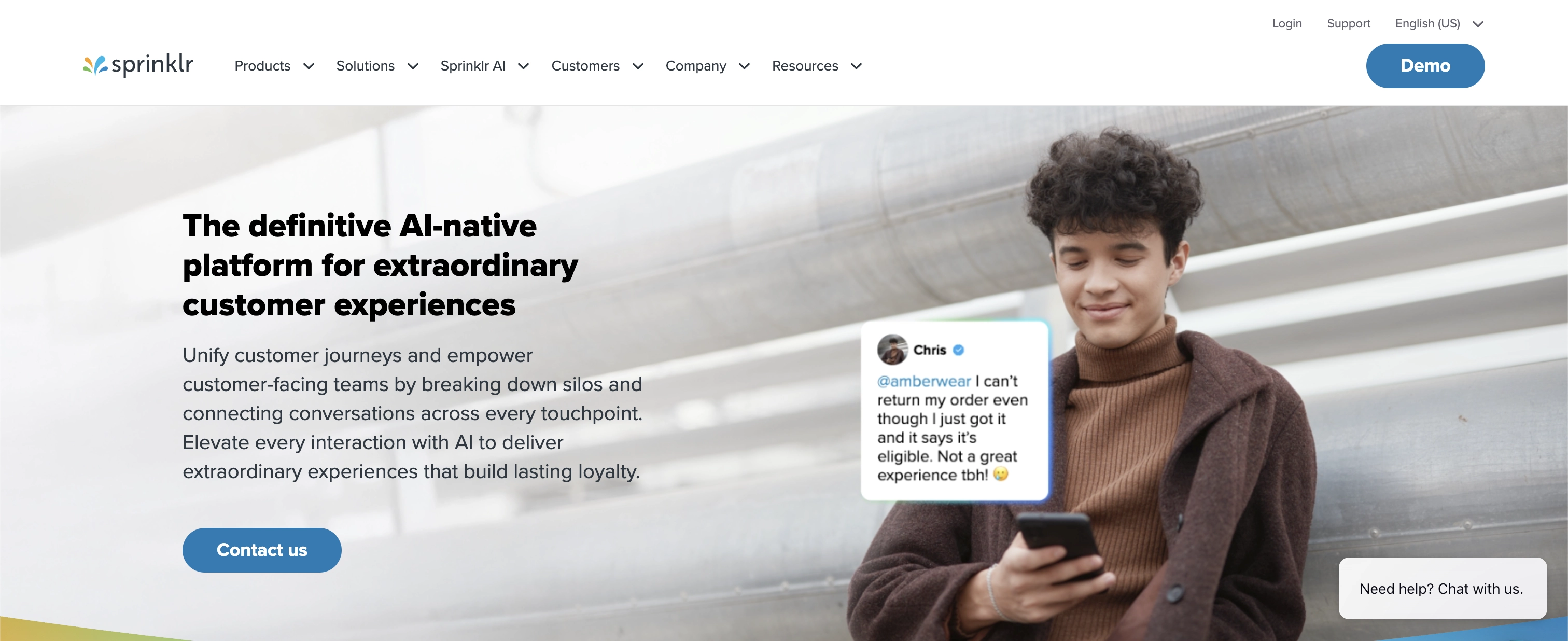
Best for: Enterprise brands managing AI-driven marketing and customer experience across high-volume social, digital advertising, and customer service channels simultaneously.
Sprinklr's unified platform connects marketing, advertising, customer service, and social listening under a single AI layer. In 2026, Sprinklr AI+ agents handle campaign orchestration, content moderation, social publishing, and customer response across dozens of channels from a single interface. The platform's enterprise governance capabilities are among the most developed in the market.
Standout features: Unified channel management across social, advertising, and service; AI-driven content performance optimization; enterprise governance and brand safety controls; global scalability.
Pricing: Custom enterprise pricing, typically $1,500+/month at mid-market entry.
CT Labs note: Sprinklr is best suited for large enterprises with significant social and digital advertising volume. Implementation complexity is high.
10. Metadata.io

Best for: B2B demand generation teams that need autonomous AI agents managing paid media campaigns across LinkedIn, Facebook, and Google.
Metadata.io operates specifically in the paid media automation space, using AI agents to create, test, and optimize B2B ad campaigns autonomously. The platform handles audience targeting, creative testing, budget allocation, and bid management without requiring manual campaign management at the individual ad level. In 2026, Metadata's agents integrate with major CRM platforms to tie paid media activity directly to pipeline outcomes.
Standout features: Autonomous paid media campaign management; B2B audience targeting with intent data; CRM-connected revenue attribution; creative testing at scale.
Pricing: Custom enterprise pricing.
CT Labs note: Metadata is the strongest purpose-built option for B2B paid media automation. Organizations seeking broader multi-channel marketing agent capabilities need to pair it with additional platforms.
AI Agents vs. AI Automation: What's the Difference and How to Choose?
The distinction matters for buying decisions.
AI automation follows programmed logic. It triggers actions based on conditions defined by a human in advance. It is reliable, predictable, and efficient for stable, repeatable processes. If the condition is met, the action fires. If the condition is not in the rules, nothing happens.
AI agents reason about context and decide on actions. They pursue goals rather than follow scripts. They handle novel situations, decompose complex tasks into steps, and adapt to changing signals without needing a human to update the rule set.
For enterprise marketing teams, the practical implication: AI automation handles sequences you know well and run repeatedly. AI agents handle workflows that require judgment, adapt to individual customer signals, or span multiple systems that need to be coordinated in real time.
Enterprise and mid-market teams with complex, multi-system marketing stacks benefit most from genuine agentic platforms. SMB teams with simpler processes and a single primary platform often extract strong value from AI-assisted automation without the complexity of full agent deployment.
CT Labs' approach for US enterprise clients focuses on deploying agents with defined scope, explicit integration points, and governance controls, matching the agent's autonomy level to what the organization's infrastructure and compliance requirements support.
Implementation and Adoption: Best Practices for Success
The platform decision is the starting point, not the finish line. Marketing teams that realize the strongest returns from AI agents follow consistent practices.
Start with a high-volume, well-defined workflow. Lead nurturing sequences, content repurposing pipelines, and paid media optimization are strong starting points. They have clear inputs and outputs, and performance data is available for before-and-after comparison.
Establish baselines before deployment. Measure your current conversion rates, response times, and cost per outcome before the agent goes live. Without baselines, the ROI case is impossible to make with confidence.
Define human escalation points. Agents operating in marketing contexts make decisions that affect brand perception and customer relationships. Define in advance which action types require human review before execution, particularly for external communications and budget commitments above defined thresholds.
Invest in adoption alongside deployment. Marketing teams that understand what the agent is doing and why use it more effectively and catch errors earlier. Training on agent oversight is as important as technical implementation.
Pitfalls to avoid: Over-relying on agent output without human review of brand-sensitive content; deploying agents before integration testing against production data; selecting platforms based on feature lists rather than actual workflow fit; and ignoring governance requirements until a compliance issue surfaces.
FAQs: Choosing and Using AI Marketing Agents in 2026
What is the typical pricing for AI marketing agents?Pricing varies significantly by category. SaaS platforms like HubSpot Breeze AI are included in existing subscriptions at $800–$3,600/month. Specialized agents like Jasper run $49–$125/seat/month. Enterprise platforms including Salesforce Agentforce, 6sense, and Sprinklr use custom pricing. CT Labs structures pricing around a defined ROI target, with project investment typically in the $500K–$2M range for enterprise deployments targeting $10M–$20M in returns.
Can AI agents replace human marketers?No. AI marketing agents replace the manual execution of defined workflows, not the strategic, creative, and relational work that produces differentiated marketing outcomes. The most effective deployments free marketing teams from repetitive task execution to focus on strategy, creative direction, and the judgment calls that agents are not designed to make.
How do I measure ROI from AI marketing agents?Establish baselines before deployment across the metrics most relevant to your workflows: lead response time, campaign cycle time, cost per lead, conversion rates, and team hours allocated to manual tasks. Measure the same metrics post-deployment over a comparable period, controlling for seasonal variation. For enterprise deployments, tie agent activity to pipeline and revenue outcomes, not just activity volume.
How does CT Labs support implementation and onboarding?CT Labs provides a working agent demo on your specific workflow before full commitment, defines the ROI target before build begins, and delivers milestone-based measurement throughout the engagement. Implementation includes governance architecture, integration with existing enterprise systems, and ongoing optimization support.
Ready to Modernize Your Marketing? Explore CT Labs' AI Agents
CT Labs works with US enterprise and mid-market marketing teams to design and deploy AI marketing agents calibrated to specific ROI targets. With 30+ prebuilt marketing agents, working demos before commitment, and governance built into every deployment, CT Labs delivers production-ready marketing automation in weeks rather than months.