
A note on terminology: this guide covers commercial AI revenue agents, software systems that automate and accelerate sales and revenue operations. It does not address IRS revenue agents, which are government employees who conduct tax examinations.
AI revenue agents have moved from pilot to production across US sales organizations. 94% of sales leaders who have deployed AI agents say they are critical for meeting business demands, and organizations that have integrated agents across their revenue stack report measurable improvements in pipeline velocity, forecast accuracy, and SDR productivity. The challenge for revenue teams in 2026 is not finding an AI agent but selecting the one that fits the specific stage of the revenue funnel, the existing tech stack, and the compliance requirements of the organization.
What Are AI Revenue Agents? (2026 Update)
An AI revenue agent is a software system that perceives signals in the sales and revenue environment, plans multi-step actions, and executes those actions autonomously to advance revenue outcomes. The definition matters because the market includes three categories that are frequently conflated:
- AI assistants (Copilot-style tools): respond to prompts, generate content, answer questions. Require human initiation at every step.
- Automation tools (rule-based): execute predefined sequences on defined triggers. Reliable but brittle when inputs vary.
- AI revenue agents: perceive changing inputs (CRM data, conversation signals, prospect behavior), reason across multiple data sources, and execute multi-step actions without human instruction at each step. They adapt when conditions change.
The practical distinction: an AI assistant helps your SDR write a better email. An AI revenue agent monitors your pipeline for stalled deals, identifies the specific barrier in each case, and initiates the appropriate re-engagement sequence without the SDR deciding to do so.
Key revenue functions AI agents address in 2026: prospecting and contact enrichment, inbound lead qualification and routing, outreach sequence personalization and management, pipeline risk monitoring and escalation, meeting scheduling and follow-up automation, CRM hygiene and data enrichment, and revenue forecasting with anomaly detection.
How AI Revenue Agents Work: Automation vs. Autonomy
AI revenue agents integrate with CRM and sales stack through API connections, bidirectional data sync, and in some cases native embedding within the CRM itself. The integration depth determines what actions the agent can take: agents that only read CRM data produce insights; agents that read and write CRM data take action. For US organizations with Salesforce, HubSpot, or Microsoft Dynamics as their system of record, verify that any agent you evaluate supports your specific CRM version and can write data back reliably, not just surface dashboards.
8 Top AI Revenue Agents for Sales Teams in 2026
1. CT Labs Revenue Agent

CT Labs builds AI revenue agent orchestration for US mid-market and enterprise organizations that need compliance-aware, multi-agent revenue workflows across complex sales environments. Its approach differs from single-platform agents in one key way: it coordinates specialized agents across prospecting, qualification, pipeline management, and revenue recognition rather than applying a general-purpose agent to every revenue task.
Its architecture connects to existing CRM and sales infrastructure through open APIs, meaning it works alongside Salesforce, HubSpot, Dynamics, and custom stacks without requiring platform migration. US compliance requirements, including SOC 2 Type II, CCPA for consumer outreach data, and industry-specific regulations for financial services and healthcare sales environments, are configuration parameters rather than afterthoughts.
Core features: Multi-agent pipeline orchestration; CRM-agnostic integration; US compliance architecture; transparent action logging; human escalation for complex or compliance-sensitive decisions.
Best for: Large and mid-market and enterprise organizations with compliance requirements, multi-stage complex sales cycles, or the need for agent logic tailored to their specific revenue motion.

2. Salesforce Agentforce

Agentforce is Salesforce's native AI agent platform, embedded directly in the CRM. It handles lead nurturing, sales coaching, customer service, and pipeline forecasting for organizations already running Salesforce. Agentforce closed 29,000 deals by Q4 FY26 and delivered 2.4 billion Agentic Work Units, making it the most widely deployed commercial AI revenue agent by volume.
Best for: Salesforce-standardized organizations wanting AI agent automation without introducing a separate data layer.
Key differentiator: Deepest native CRM integration available; no translation layer required. Limited flexibility for non-Salesforce environments.
3. Gong
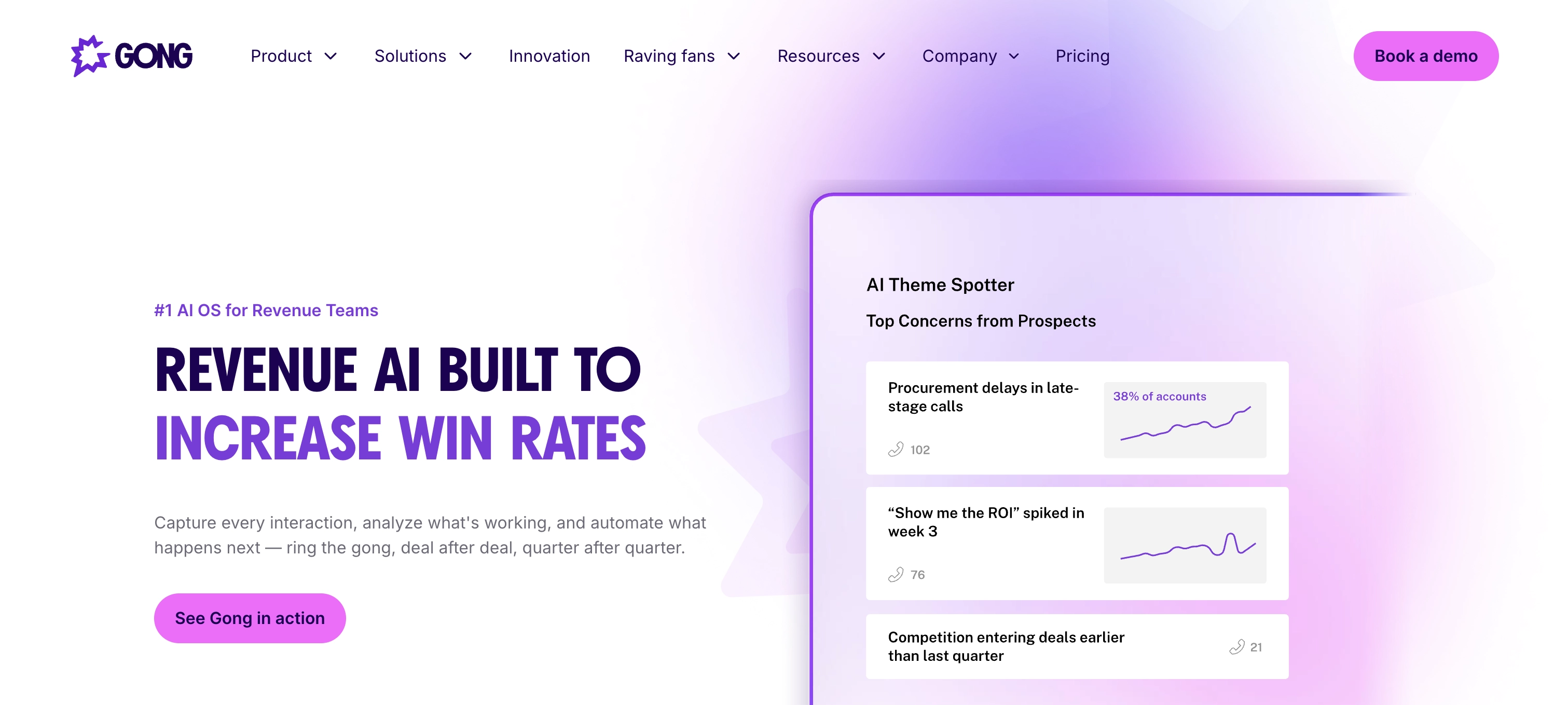
Gong crossed $500M ARR in 2026 and launched Mission Andromeda, evolving from a revenue intelligence platform to a multi-agent revenue operating system. Its agents analyze call recordings, email threads, and meeting data to surface deal risk, coaching recommendations, and competitive signals automatically.
Best for: B2B sales organizations where conversation intelligence and rep coaching drive revenue outcomes.
Key differentiator: Proprietary dataset of sales conversations for model training; strongest signal for deal risk detection based on conversation patterns.
4. Clari + Salesloft
The merged Clari and Salesloft platform combines Clari's forecast intelligence with Salesloft's sales engagement, serving over 5,000 organizations with an integrated revenue AI layer. Its AI agents monitor pipeline health, flag forecast risks, and trigger re-engagement sequences based on deal behavior patterns.
Best for: Enterprise sales organizations needing accurate pipeline forecasting and coordinated sales engagement from a single platform.
Key differentiator: $10T in revenue under management produces forecasting models trained on data scale most platforms cannot match.
5. HubSpot Breeze

HubSpot Breeze is HubSpot's AI layer, replacing ChatSpot with a more deeply embedded agent architecture across the CRM, sales hub, and marketing hub. Breeze agents handle prospecting, lead scoring, sequence personalization, and pipeline analytics within the HubSpot ecosystem.
Best for: SMB and mid-market organizations on HubSpot seeking accessible AI revenue automation without additional platform investment.
Key differentiator: Fastest time-to-value for HubSpot users; no integration setup required. Less flexible outside the HubSpot ecosystem.
6. Lindy.ai
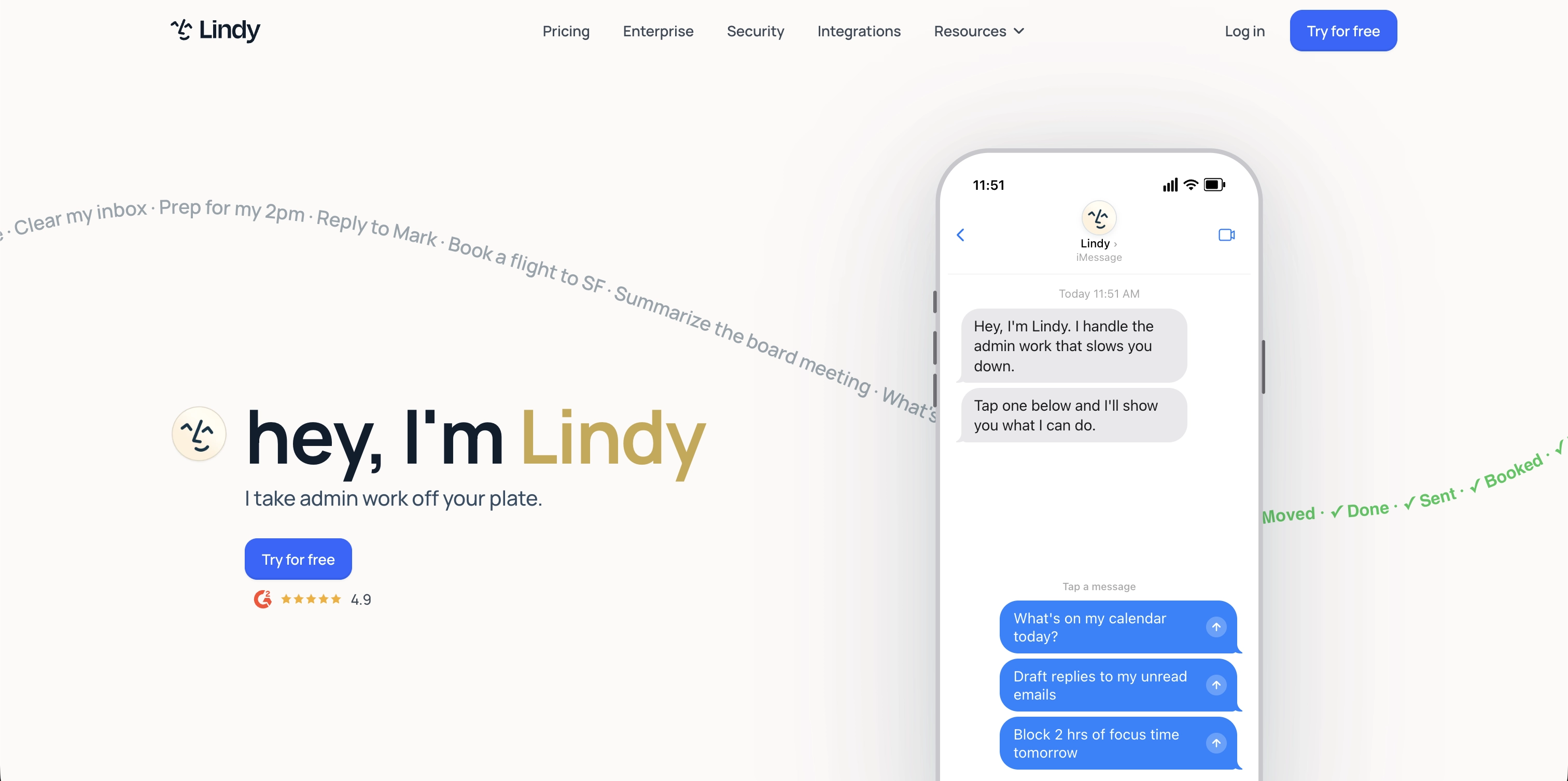
Lindy.ai provides AI agent templates for sales workflows including lead qualification, outreach personalization, meeting scheduling, and follow-up management. Its no-code configuration model allows revenue teams to deploy agents without engineering support, making it accessible for organizations without dedicated RevOps technical resources.
Best for: Growth-stage companies that want to deploy sales workflow agents quickly without an engineering engagement.
Key differentiator: No-code agent deployment; fastest setup among platforms in this list for standard sales workflow automation.
7. Bardeen
Bardeen is an AI browser automation and workflow agent that integrates with Salesforce, HubSpot, LinkedIn, and sales engagement platforms to automate data enrichment, list building, and outreach initiation. Its "Autobooks" (pre-built workflow templates) cover common SDR and AE automation tasks.
Best for: SDRs and AEs who need workflow automation across browser-based sales tools without a full RevOps platform investment.
Key differentiator: Browser-level automation that reaches tools without formal APIs; strong LinkedIn and prospect data enrichment workflows.
8. Retell
Retell deploys AI voice agents for inbound and outbound sales calls, handling initial qualification conversations, appointment scheduling, and follow-up calls at scale. Its voice AI is designed for US English with natural conversation flow rather than scripted response patterns.
Best for: Sales organizations with high inbound call volume or outbound qualification requirements where voice interaction is the primary sales channel.
Key differentiator: Production-ready voice AI specifically designed for US English sales conversations; integrates with major CRMs for call logging and lead status updates.
How to Select the Right AI Revenue Agent: Decision Framework
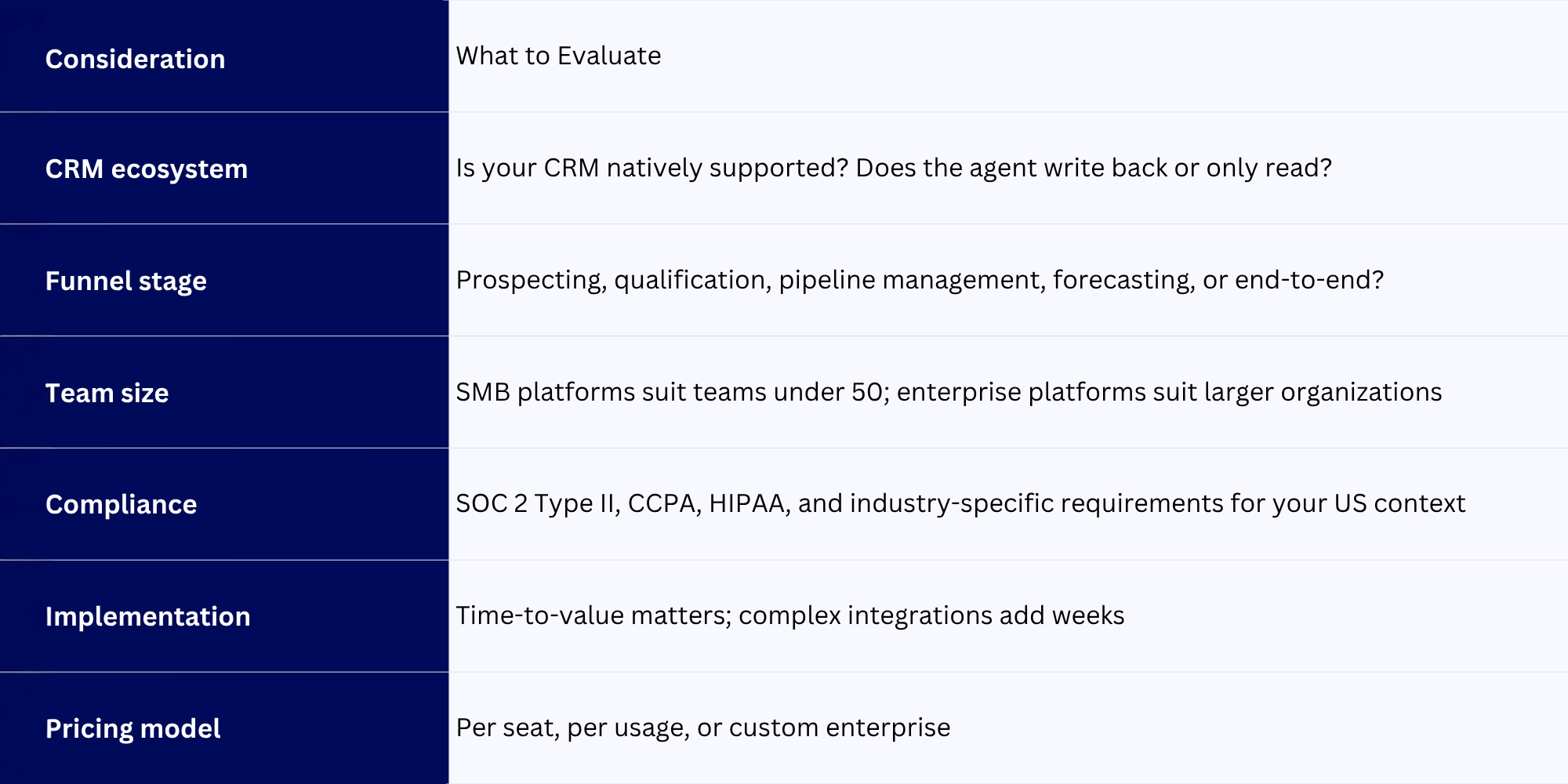
Common pitfalls:
- Selecting based on demo performance on clean data; request a POC on your actual CRM data
- Underestimating integration complexity for non-standard CRM configurations
- Deploying agents without defining what human review is required for compliance-sensitive outreach
- Choosing a platform standardized on a CRM you do not use primarily
Quick selection guide:
- Using Salesforce as your primary CRM: Agentforce or CT Labs
- Using HubSpot: HubSpot Breeze or CT Labs
- High outbound volume: 11x, Bardeen, or Lindy.ai
- Voice-first sales: Retell
- Revenue forecasting priority: Clari + Salesloft
- Conversation intelligence: Gong
- Compliance-critical or complex pipeline: CT Labs
FAQs on AI Revenue Agents in 2026
How secure are AI revenue agents with sensitive sales and prospect data?
Enterprise-grade AI revenue agents maintain SOC 2 Type II certification and offer US data residency for organizations with data localization requirements. For B2B outreach, verify that the agent's prospect data sourcing and email outreach comply with CAN-SPAM, CCPA for California-resident contacts, and any sector-specific regulations for your industry. Request the vendor's data processing agreement and security documentation before procurement, not after.
What are typical implementation timelines?
Native CRM-embedded agents (Agentforce, HubSpot Breeze) deploy in one to three weeks for standard configurations. Platform agents with pre-built connectors (Gong, Clari) run three to six weeks for integration and configuration. Custom multi-agent orchestration deployments (CT Labs) run eight to sixteen weeks for enterprise implementations. Organizations that skip the configuration validation and pilot phase consistently encounter production failures that a structured deployment process would have prevented.
How do AI revenue agents impact SDR and AE roles?
AI revenue agents redirect SDR and AE time from administrative and low-judgment tasks (CRM updates, initial outreach sequences, meeting scheduling, data enrichment) to high-judgment tasks (complex conversation management, enterprise relationship building, negotiation, and deal structuring). Organizations that have deployed agents report that SDRs spend 30% to 50% more time in direct prospect conversations after agent deployment. The risk is skill atrophy in outreach and qualification if agents fully replace practice in those areas for junior sales staff.
What does CT Labs' onboarding process look like?
CT Labs implementations begin with a structured workflow mapping session that documents the specific revenue processes, CRM configuration, compliance requirements, and integration architecture before any agent configuration begins. A 30 to 60 day pilot on a representative subset of production pipeline validates agent performance against defined metrics before full deployment. Post-deployment support includes monthly performance reviews and configuration updates as the sales environment evolves. Contact CT Labs at ctlabs.ai for a discovery call.