
AI agents vs chatbots is an important distinction for enterprise leaders evaluating how to automate workflows, improve decision-making, and scale AI across the business.
A few years ago, most business conversations about AI centered on chatbots. Today, enterprise leaders are hearing about AI agents, agentic AI, autonomous workflows, and AI-powered operations. The terms are often used interchangeably - but they are not the same thing.
A chatbot can answer a question. An AI agent can help complete a process.
That distinction is better execution across workflows, systems, and teams. For enterprise leaders evaluating where to invest, understanding the difference is the starting point for making the right call.
Sometimes a chatbot might seem like a quick, simple answer. Other times, implementing an AI agent may actually provide exponentially more value to a business.
Read this article to get a sense of when you might need an AI agent vs. a chatbot. Then, reach out to an AI strategy consultant to determine if there is exponentially more value to your business and the potential to increase revenue with an AI agent.
What Is a Chatbot?
Chatbots are AI-powered interfaces designed to respond to user inputs. They are commonly used for customer support, internal help desks, FAQs, website engagement, and basic information retrieval.
They are most useful when the task is narrow, repetitive, and conversation-based. A well-designed chatbot can handle high volumes of routine requests without human involvement. They reduce wait time, free up staff, and deliver consistent responses at scale.
Common chatbot use cases include:
- Answering customer questions about products, policies, or orders
- Helping employees find HR policies or benefits information
- Routing and triaging support requests
- Collecting intake information before handing off to a human
- Providing basic product or service guidance on a website
Chatbots operate within a defined scope. They respond. But they do not act.
What Is an AI Agent?
AI agents are systems designed to pursue a goal, make decisions, take actions, and complete multi-step tasks using connected tools, data, and systems.
An AI agent can be given an objective and work through the steps required to get there. It can complete processes, monitor systems, and resolve exceptions. Agents can call external APIs, query databases, update records, trigger downstream workflows, and hand off tasks to other systems or humans when appropriate.
Common AI agent use cases include:
- Reviewing invoices and routing exceptions based on business rules
- Pulling data from multiple systems to generate a consolidated report
- Monitoring IT tickets and recommending next actions based on priority and history
- Supporting quote-to-cash workflows with automated status updates
- Updating CRM records based on sales activity across email and calls
- Coordinating steps across HR, finance, operations, or IT workflows
This is also where AI workflow automation becomes relevant. Agents are not standalone tools. They are part of a larger system design. They connect to the data, integrations, and governance needed to make automation reliable at scale.
How Agentic Technology Is Transforming Workflows in 2026
AI Agents vs. Chatbots: The Key Differences
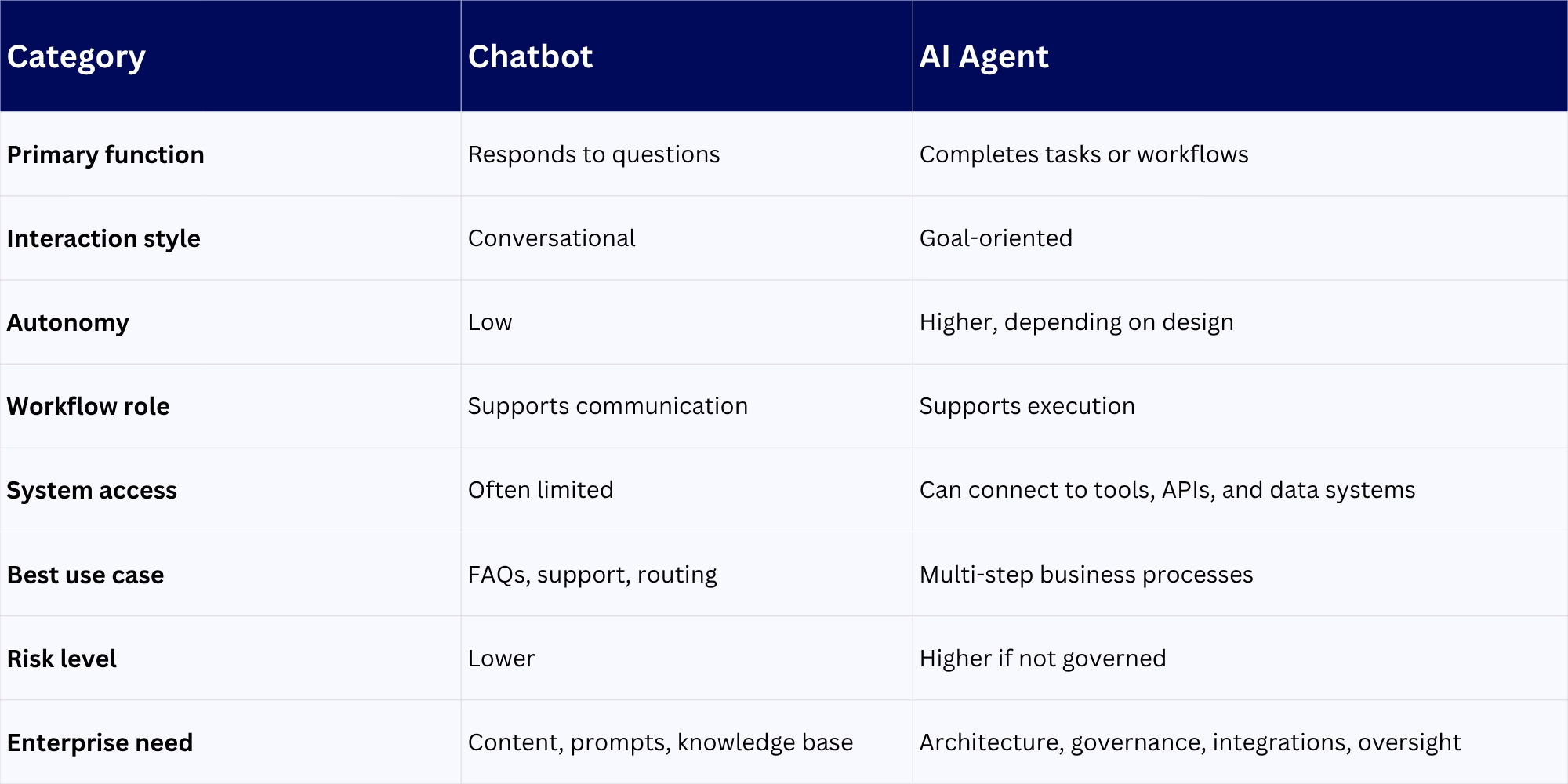
The table above is a useful reference, but the real distinction is this: chatbots improve how people get information; agents improve how work gets done.
Why This Difference Between AI Agents vs Chatbots Matters for Enterprise Leaders
Enterprise leaders need AI agents that solve a specific business problem.
A chatbot may improve response time. On the other hand, an AI agent may reduce manual work, accelerate a process, or improve operational throughput. Those are different categories of value — and they require different levels of investment, infrastructure, and oversight.
The gap between expectation and execution is real. Many organizations are excited about agentic AI but are still struggling to operationalize it. The friction points with AI agents are consistent. Enterprise companies deal with governance gaps, unclear integration paths, insufficient human oversight, and the absence of a clear ROI model before the build begins.
That friction is the reason enterprise companies should approach AI agents with more rigor than most AI pilots have received.
When a Chatbot Is the Right Choice
A chatbot may be the right tool when the business need is relatively contained. Not every problem requires an agent. Deploying an AI agent when a chatbot would suffice adds unnecessary complexity and cost.
When to choose a chatbot vs. an AI agent.
Consider a chatbot when the goal is to:
- Handle high volumes of routine customer support questions
- Give employees fast access to HR policies, IT procedures, or internal knowledge
- Automate FAQ responses across a website or portal
- Qualify leads before routing to a sales team
- Collect intake information before connecting with a human agent
Essentially, if the goal is to answer common questions faster and more consistently, a chatbot may be the right tool. The implementation is more straightforward, the risk profile is lower, and the time-to-value is typically shorter.
When an AI Agent Is the Better Choice
An AI agent becomes the better fit when the work involves multiple steps, multiple systems, or decisions that require context — not just retrieval.
When to choose an AI agent vs. a chatbot
Consider an AI agent when the goal is to:
- Automate multi-step workflows across connected systems
- Coordinate actions between HR, finance, operations, or IT
- Support decision-making with real-time data retrieval and synthesis
- Handle exceptions and escalations based on defined business rules
- Monitor processes and flag issues without waiting for human review
- Build in human-in-the-loop approvals at defined checkpoints
- Generate measurable operational outcomes, not just faster responses
If the goal is to move work forward — not just answer questions — an AI agent may be the better fit. The implementation is more involved, but the potential impact is also higher.
The Enterprise Risks of AI Agents
AI agents operate differently from chatbots; that means the risk profile is different.
AI Agents can interact with sensitive systems, trigger actions, access confidential data, and influence business decisions. Sometimes AI agents operate across multiple platforms simultaneously. Without the right controls in place, that capability can become a liability.
Enterprise leaders deploying AI agents need clear governance frameworks that address:
- Access permissions: Which systems can the agent read from, write to, or trigger?
- Data privacy: How is sensitive or regulated data handled within agent workflows?
- Human oversight: At what points does a human need to review or approve agent actions?
- Audit logs: Is there a complete record of what the agent did, when, and why?
- Error handling: What happens when the agent encounters an unexpected state?
- Security: How are agent credentials, API access, and data flows protected?
- Compliance: Does agent behavior align with regulatory requirements in your industry?
- Escalation rules: What triggers a handoff to a human, and how is that handoff managed?
Enterprise adoption of agentic AI is accelerating, and recent coverage of the space has consistently emphasized that governance is the gap most organizations underestimate. Building controls in from the start is not optional — it’s what separates a production-ready agent from an experiment that stalls.
How to Choose the Right AI Agent for Your Enterprise in 2026
How to Decide What Your Business Needs
Before committing to a chatbot vs. AI agent, enterprise leaders should work through a few foundational questions:
- Is the task conversational or operational?
- Does the system need to answer, recommend, or act?
- Does it require access to internal tools, APIs, or data systems?
- Does it involve multiple steps or decision points?
- What is the cost of an error — and who is accountable?
- Does a human need to approve certain actions before they are executed?
- How will ROI be defined and measured?
The answers will point in one of three directions:
- Choose a chatbot for simple, repetitive, conversation-based interactions.
- Choose an AI agent for structured, repeatable workflows that require action across systems.
- Choose a governed AI agent strategy when the work touches sensitive data, business-critical systems, or measurable operational outcomes — and when accountability matters.
That third option is where most enterprise AI decisions ultimately land. And it’s also where the implementation complexity tends to be underestimated.
From Chatbots to Enterprise AI Agents
The next phase of enterprise AI is about identifying the right workflows, designing the right agent architecture, integrating with the right systems, and building governance from the start.
That is where many organizations get stuck. They run pilots, build demos, and generate internal enthusiasm — but they don’t have a clear path from experimentation to production. The agents never ship. The ROI never materializes. The initiative stalls.
Moving from pilot to production requires more than technical capability. It requires a clear methodology. You must identify which workflows have the highest ROI potential, validating the approach through a structured proof of concept, and then building for scale with the right integrations, controls, and oversight in place.
CT Labs works with enterprise teams at each stage of that process — from initial workflow discovery through production deployment. The goal is not to add another AI experiment to the roadmap. It is to ship agents that deliver measurable results.

Where to Start When Choosing AI Agents vs. Chatbots
When comparing AI agents vs chatbots, the right choice depends on whether your business needs simple conversation support or autonomous workflow execution.
Chatbots are useful for conversations. AI agents are built for execution.
For enterprise leaders, the question is not which one is "better." The better question is: what kind of work are you trying to improve?
If the goal is faster answers to common questions, a well-designed chatbot may be enough. If the goal is workflow automation, operational efficiency, and measurable ROI, it may be time to explore what enterprise AI agents can actually deliver.
Keep in mind that sometimes it may seem like a chatbot is enough, other times, an AI agent can provide true value that can really accelerate a company’s growth and revenue.
If your organization needs a technology executive to help with these critical, high-impact decisions, reach out to IT Executive Search Firm, Christian & Timbers.
What does it take to deploy them responsibly?
Not sure whether your business needs a chatbot, an AI agent, or a broader AI workflow strategy?
CT Labs helps enterprise teams identify high-value automation opportunities, evaluate agent readiness, and move from AI experimentation to production-ready deployment.