The US HR and payroll software market reached $16 billion in 2026, driven by three converging pressures: increasingly complex multi-state compliance requirements, accelerating AI adoption in workforce operations, and employee expectations for self-service that legacy platforms were not designed to meet. Gartner estimates that 50% of current HR activities will be automated or performed by AI agents by the end of 2026, a structural shift that has separated platforms built for the AI era from those retrofitting it.
For HR managers, payroll administrators, and CHROs evaluating platforms today, the differentiation is no longer features on a checklist. It is the depth of AI integration, the reliability of US-specific compliance coverage, and the architecture that determines whether the platform grows with the organization or requires replacement at the next stage.
This guide covers the 12 platforms that best represent the current market, with US compliance context current as of 2026.
How to Choose the Right HR and Payroll Platform
Before comparing vendors, narrow the decision to four criteria that vary most by organization.
US compliance depth. Multi-state employers face a compliance environment that changed materially in January 2026: California raised its executive and administrative exemption threshold to $1,352 per week, New York to $1,275 per week in NYC and surrounding counties, and Washington to $1,541.70 per week. FLSA misclassification remains the highest-risk compliance exposure for US employers. Platforms that automate threshold monitoring and flag classification changes reduce that risk. Platforms that leave it to manual review do not.
AI capability depth. The meaningful distinction is between platforms offering AI-powered workflows that take action (automating onboarding steps, processing payroll runs, flagging anomalies, routing approvals) versus platforms that surface AI-generated recommendations for humans to act on. For organizations at scale, the former produces measurable time and cost reduction; the latter produces useful suggestions that still require the same headcount to execute.
Integration architecture. HR and payroll do not operate in isolation. The platform's ability to connect with your existing HRIS, ERP, benefits broker, time and attendance system, and communication tools determines whether it becomes a system of record or a separate data silo that adds reconciliation work.
Implementation timeline. Timelines vary from two to four weeks (Deel, DianaHR) to six to twelve months (Workday). Organizations that need to address compliance gaps or fill a vacancy in the finance technology stack before the next payroll cycle cannot absorb a 26-week implementation.
CriterionSMB PriorityMid-Market PriorityEnterprise PriorityUS compliance automationHighHighHighAI workflow depthMediumHighHighIntegration breadthMediumHighHighImplementation speedHighMediumLowMulti-state/global supportLow–MediumMedium–HighHigh
Top 12 HR and Payroll Solutions for US Businesses in 2026
The 12 platforms below were selected based on US market adoption, compliance coverage, AI capability, and relevance across company stages. Details reflect platform capabilities as of 2026.
1. CT Labs

CT Labs approaches HR and payroll as an AI workflow problem, not a software configuration problem. Its platform deploys configurable AI agents across onboarding, payroll processing, benefits administration, and compliance monitoring, with US-specific compliance rules built into the agent logic rather than maintained as manual policy updates.
The key differentiator is workflow configurability: CT Labs agents adapt to the organization's existing processes and systems rather than requiring the organization to adapt to the platform's predefined workflows. This is particularly relevant for companies with non-standard employment structures, multi-state operations, or complex benefits arrangements that generic platforms handle poorly.
US compliance coverage includes FLSA threshold monitoring, state-level exemption tracking, ACA reporting, and I-9 verification workflows. For organizations already running HR operations on other platforms, CT Labs integrates as an AI layer on top of existing systems, automating the manual work without requiring a full platform migration.
Best for: Mid-market US organizations running complex workflows across multiple states, companies seeking AI-native process automation without full platform replacement.

2. ADP Workforce Now

ADP is the largest payroll processor in the US, handling payroll for one in six American workers. Its Workforce Now platform combines payroll processing, benefits administration, time and attendance, and HR management with a compliance engine that automatically updates for federal and state regulatory changes.
ADP's depth is in payroll tax accuracy, garnishment management, and compliance reporting. Its workforce analytics suite, built on decades of aggregated payroll data, produces benchmarking insights that smaller platforms cannot replicate. Where ADP is less competitive is in UI modernity and implementation speed. Implementation typically runs 8 to 16 weeks and the platform reflects its enterprise-first architecture in complexity.
Best for: Mid-market to enterprise US companies that prioritize payroll accuracy, compliance depth, and access to aggregate workforce benchmarks.
3. Rippling
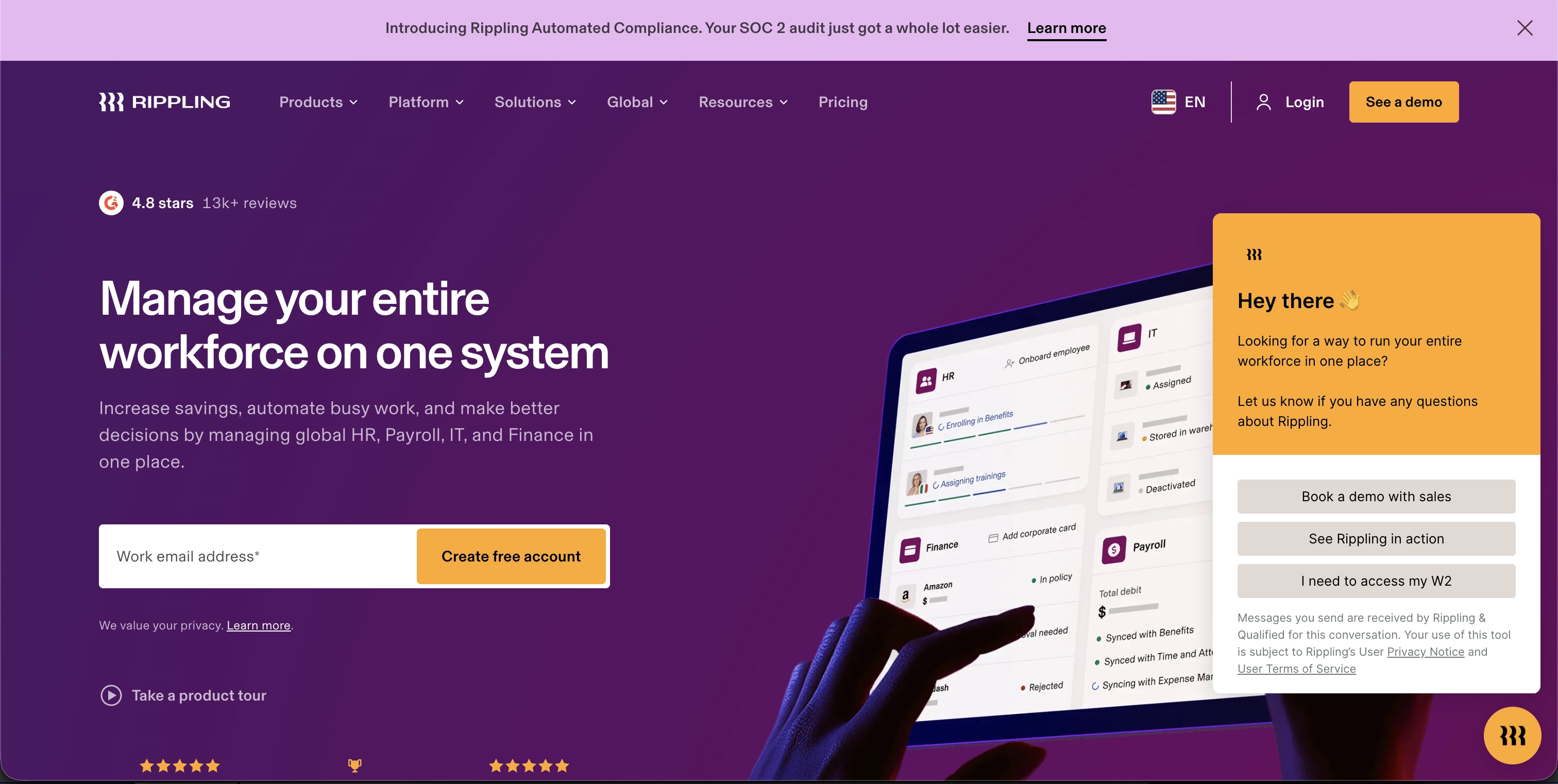
Rippling differentiates by combining HR, IT, and finance infrastructure in a single platform. Beyond payroll and HRIS, Rippling handles device provisioning, application access management, and expense reporting, making it the only platform where an employee termination can simultaneously run final payroll, revoke application access, and ship a device return label.
For organizations where HR, IT, and finance operate as separate systems with manual handoffs between them, Rippling's unified architecture eliminates a category of reconciliation work. Implementation runs two to eight weeks, considerably faster than enterprise alternatives. Its US payroll compliance is strong across all 50 states. Rippling has added AI-powered automations across its workflow engine, including trigger-based actions that execute HR workflows when conditions are met without manual initiation.
Best for: Technology-forward SMB and mid-market companies that want HR, IT, and finance in one system.
4. Gusto
Gusto is the clearest choice for US-based SMBs that need payroll, benefits, and compliance without the implementation complexity of enterprise platforms. Its automated payroll runs with direct deposit, handles all federal and state tax filings, and manages new hire reporting automatically. Benefits administration covers health, dental, vision, and 401(k) with direct integration to major carriers.
Gusto's limitation is scale: it is purpose-built for companies under approximately 500 employees and begins to show gaps in configurability and reporting depth as organizations grow. Its AI capabilities are primarily in the suggestions and anomaly detection category rather than agentic workflow execution. For straightforward US payroll with strong compliance coverage, it is difficult to beat on price and usability at the SMB tier.
Best for: US-based SMBs with straightforward domestic payroll, benefits, and compliance needs.
5. Workday HCM

Workday is the enterprise benchmark for organizations that need real-time HR and financial data in a single system. Its HCM suite covers the full employee lifecycle alongside financial management, workforce planning, and analytics at a depth that smaller platforms do not reach. For public companies and large enterprises with complex reporting requirements, Workday's integration of HR and finance data provides the consolidated visibility that boards and audit committees expect.
The trade-offs are cost and implementation timeline. Implementation runs six to twelve months and requires significant internal resources. Licensing and implementation together make Workday a material capital commitment. For organizations that have crossed the threshold where that investment is justified, the platform's depth in workforce planning, compliance reporting, and financial integration is unmatched.
Best for: Large enterprises and public companies that need deep HR and finance integration with enterprise-grade compliance reporting.
6. Deel
Deel's primary use case is international hiring: Employer of Record services, contractor payment processing, and multi-country payroll across 150+ countries. For US companies hiring internationally or managing a distributed contractor workforce, Deel removes the legal and administrative complexity of engaging workers across different employment frameworks.
In the US, Deel handles contractor payment compliance, W-9 and 1099 management, and state-level employer registration for companies expanding to new states. It has added HR and payroll capabilities for US employees, making it competitive for companies with mixed domestic and international workforces who want a single system. Implementation runs two to four weeks, the fastest in the enterprise category.
Best for: US companies with significant international headcount or contractor operations across multiple countries.
7. HiBob
HiBob is built for the employee experience layer of HR: engagement, culture, performance management, and people analytics alongside core HRIS functionality. Its interface is among the most modern in the category, which drives the adoption rates that determine whether HR data is current enough to be useful.
HiBob's US payroll capabilities require integration with a payroll processor (it connects natively with ADP, Gusto, and others) rather than processing payroll directly. This means HiBob works best as the HRIS system of record alongside a dedicated payroll platform. For mid-sized US companies prioritizing retention, culture, and manager effectiveness data, HiBob's analytics and engagement tooling are differentiated. Implementation runs six to ten weeks.
Best for: Mid-sized US companies that prioritize employee engagement data and modern HR experience, paired with a dedicated payroll processor.
8. DianaHR
DianaHR is an AI-native HR platform built specifically for startups, combining AI automation that handles 90% of HR work with human HR specialists for edge cases. It deployed the first production-grade AI agent for employee onboarding in January 2026, executing the full onboarding workflow with minimal human intervention.
DianaHR integrates with ADP, Gusto, Rippling, and other payroll platforms, functioning as an AI HR operations layer on top of existing payroll infrastructure. For early-stage companies that need professional HR operations without building an internal HR team, DianaHR's combination of AI automation and specialist support fills the gap at a cost structure that fits the stage.
Best for: US startups and early-stage companies that need full-service HR without building an internal HR function.
9. Leena AI
Leena AI is an autonomous HR agent platform designed for enterprise organizations. Its model is to reduce ticket volume by having the AI agent take direct action in existing systems rather than routing requests to HR staff. Leave requests, expense queries, policy questions, and IT access issues are handled end-to-end by the agent, with human escalation reserved for requests outside its defined scope.
Leena AI connects to existing HRIS, ITSM, and payroll platforms as an action layer rather than replacing them. For large enterprises with high HR service ticket volume and the infrastructure to support an agent integration project, the reduction in HR case load is measurable. It requires more implementation investment than SMB-oriented platforms.
Best for: Large enterprises with high HR service ticket volume seeking to reduce operational load through agentic automation.
10. Sana
Sana operates at the intersection of HR, learning management, and knowledge management. Its AI agents connect across existing HR systems, documentation repositories, and communication tools to both answer employee questions and take actions inside those systems. For organizations where the same employee question (how do I update my benefits election, who approves my PTO, what is the parental leave policy) gets answered differently by different people in different channels, Sana creates a single consistent agent-driven interface.
Sana's strength is in knowledge-intensive organizations where employee self-service quality directly affects productivity. Its payroll and compliance coverage is lighter than dedicated payroll platforms; it works best in combination with a core payroll system.
Best for: Mid-to-enterprise organizations that want a unified HR and knowledge management agent layer on top of existing systems.
11. MindStudio
MindStudio is an AI agent builder that HR teams use to create custom automation workflows without requiring engineering resources. Rather than a pre-packaged HR platform, MindStudio provides the infrastructure to build and deploy agents for specific HR processes: candidate screening, onboarding document collection, policy acknowledgment workflows, benefits enrollment reminders, and similar repeatable tasks.
For HR teams with clearly defined repetitive workflows that no off-the-shelf platform handles exactly right, MindStudio enables custom automation without a software development project. The trade-off is that building effective agents requires process clarity and ongoing maintenance that a managed platform provides out of the box.
Best for: HR teams with specific automation needs that generic platforms do not address, and the internal capacity to build and maintain custom agent workflows.
12. Stealth Agents
Stealth Agents provides AI-powered virtual staffing for HR functions, combining AI agents with human-in-the-loop support for HR operations tasks including recruitment support, employee communications, onboarding coordination, and administrative processing. It operates as a service layer rather than a platform, making it relevant for organizations that want HR operations coverage without building internal capacity or configuring a platform.
Best for: SMBs and scaling companies that need HR operations support through a managed service model combining AI automation with human oversight.
Feature Deep Dive: What Sets Leaders Apart
PlatformAI Workflow DepthUS CompliancePayroll NativeImplementationBest StageCT LabsConfigurable agentsMulti-state, FLSAVia integration2–4 weeksMid-marketADP Workforce NowModerateDeepest in classYes8–16 weeksMid to enterpriseRipplingHigh (trigger-based)All 50 statesYes2–8 weeksSMB to mid-marketGustoModerateStrong, US-onlyYes1–2 weeksSMBWorkday HCMHighEnterprise-gradeYes6–12 monthsEnterpriseDeelModerateUS + 150 countriesYes2–4 weeksInternational-heavyHiBobModerateHRIS onlyVia integration6–10 weeksMid-marketDianaHRHigh (agentic)Startup-focusedVia integration1–2 weeksStartupsLeena AIHigh (agentic)EnterpriseVia integration4–8 weeksEnterpriseSanaHigh (knowledge + HR)ModerateVia integration4–8 weeksMid to enterpriseMindStudioCustom-builtDepends on buildVia integrationVariesAny (DIY)Stealth AgentsAI + human hybridModerateVia service1–2 weeksSMB
Why CT Labs? CT Labs deploys configurable AI agents across payroll, onboarding, benefits, and compliance workflows, with US-specific compliance logic built into the agent layer rather than managed as manual updates. For mid-market organizations running complex multi-state operations or non-standard employment structures, CT Labs automates the highest-friction HR processes without requiring a full platform migration. Explore CT Labs
FAQs: HR and Payroll in 2026
How do AI-powered tools handle sensitive payroll and HR data?
Leading platforms use SOC 2 Type II certification, AES-256 encryption at rest and in transit, and role-based access controls that limit data visibility to authorized users. AI agents operating on payroll data work within permission boundaries defined by the platform administrator, meaning they access only the data required to complete the specific workflow they are executing. For organizations subject to HIPAA (health benefits data), CCPA, or other state privacy laws, verify that the platform's data processing agreements cover those frameworks before contracting.
What compliance changes affect US businesses in 2026?
The most consequential changes as of January 2026 are the state-level salary threshold increases for FLSA overtime exemptions. California, New York, Washington, and several other states raised their minimum salary requirements for executive, administrative, and professional exemptions. Employers who did not adjust salaries before January 1 may have reclassified employees creating overtime liability. FLSA misclassification, particularly for workers with manager titles who do not meet the duties test, remains the highest-risk compliance exposure area. Platforms that automate threshold monitoring and alert HR to changes in employee status reduce audit and litigation exposure.
How does HR and payroll automation reduce errors and save cost?
77% of HR executives report using AI in payroll processing in 2026, with the primary benefit being the elimination of manual data entry errors that create tax filing corrections, payroll adjustments, and compliance penalties. Automated payroll runs also reduce the per-payroll processing time that HR and finance staff spend on calculation, review, and filing. For organizations running biweekly payroll across multiple states, the compliance monitoring that automated platforms perform continuously replaces the equivalent of part-time compliance staff hours per pay period.
Can I switch platforms without losing data?
Yes, with preparation. Most major HR and payroll platforms support data export in standard formats, and most migration projects involve a parallel-run period where both systems process the same payroll to validate accuracy before the old system is decommissioned. The critical data categories to migrate are employee records, payroll history for YTD tax calculations, benefits enrollment, and time-off balances. Switching mid-year requires particular attention to YTD payroll figures to avoid tax filing errors. Platform vendors and implementation partners both offer migration services; for mid-market organizations, a structured migration with a defined validation period is the standard approach.
Get Started: Steps to Modernize Your HR and Payroll
Use this checklist to structure a platform evaluation before demos begin.
Before the demo:
- Document current pain points by process area (payroll errors, compliance gaps, manual onboarding steps, time-off tracking issues)
- List every system the HR and payroll platform must connect to (HRIS, ERP, benefits broker, time and attendance, communication tools)
- Identify multi-state or international requirements and the specific states where compliance monitoring is most critical
- Define the AI automation use cases that would deliver the highest time or cost reduction
- Set a budget range including implementation, first-year licensing, and ongoing support
During platform evaluation:
- Test compliance automation against your specific state footprint, not just the vendor's general compliance claims
- Ask for a reference from a customer at your company stage and industry
- Evaluate implementation timeline against your next compliance milestone or open enrollment date
- Request a data migration plan and verify what historical payroll data will carry over
CT Labs offers a structured assessment for organizations evaluating AI-native HR automation. For organizations running complex multi-state payroll or high-volume onboarding workflows, the assessment identifies which processes are the highest-value automation targets before any platform commitment. Contact CT Labs at ctlabs.ai to schedule an evaluation.