
Pick an AI partner who proves they can deliver production systems, not just polished demos. Anchor your choice to 15 criteria: real deployments that have run for 12 months, domain expertise in your industry, strong governance and security, integration with core platforms, and a plan to transfer capability to your team. Partnerships that combine tooling with deep delivery outperform DIY approaches by a wide margin Fortune.
There is a clear pilot-to-production gap. More than 80% of AI projects fail to deliver measurable impact, and up to 95% of generative AI pilots show no clear ROI (Return on Investment) Pertama Partners Fortune. This guide gives you a structured, citable checklist to separate strategy-deck producers from production-grade engineers. Use it during RFPs (Requests for Proposal) and interviews to de-risk decisions, speed time to value, and avoid vendor dependency.
Key Takeaways
- Most AI initiatives fail, so partner quality determines outcomes: more than 80% of AI projects miss measurable impact Pertama Partners.
- Beware the pilot trap: up to 95% of GenAI pilots show no clear ROI, and two-thirds of enterprises remain stuck in pilots Fortune CIO Dive.
- Deep partnerships outperform DIY: companies that purchase tools and form deep partnerships succeed about 67% of the time versus about 33% for purely internal builds Fortune.
Why Your AI Consulting Partner Choice Determines Project Success
Partner selection is the single highest leverage decision you control. More than 80% of AI projects fail to deliver measurable impact, which signals that impressive demos often mask weak production engineering Pertama Partners.
Up to 95% of generative AI pilots show no clear ROI because they stall before operationalization Fortune. Two-thirds of enterprises remain stuck in pilot mode due to privacy, cybersecurity, and data quality issues CIO Dive.
Root causes are organizational and architectural, not algorithmic. Research highlights strategy, process, and people as dominant failure modes that strong partners address through governance and change management University of Queensland. Vendor lock-in risks are real, so treat black-box pitches as a warning sign. Buyers now expect production readiness, observability, and measurable ROI as the standard in 2026.
The 15-Point AI Consultant Evaluation Checklist
Use a structured framework during RFPs (Requests for Proposal) and interviews. Assess production architecture, governance, integration with core systems, measurable outcomes, and knowledge transfer, not just model choice or slideware Centric Consulting Last Rev.
Weight criteria by business risk. Regulated industries should elevate compliance and auditability. Mid-market firms with legacy platforms should prioritize integration depth and time to first value. Specialized boutiques can often prove value in 4 to 12 weeks, which aligns with budget and adoption realities Dan Cumberland Labs.
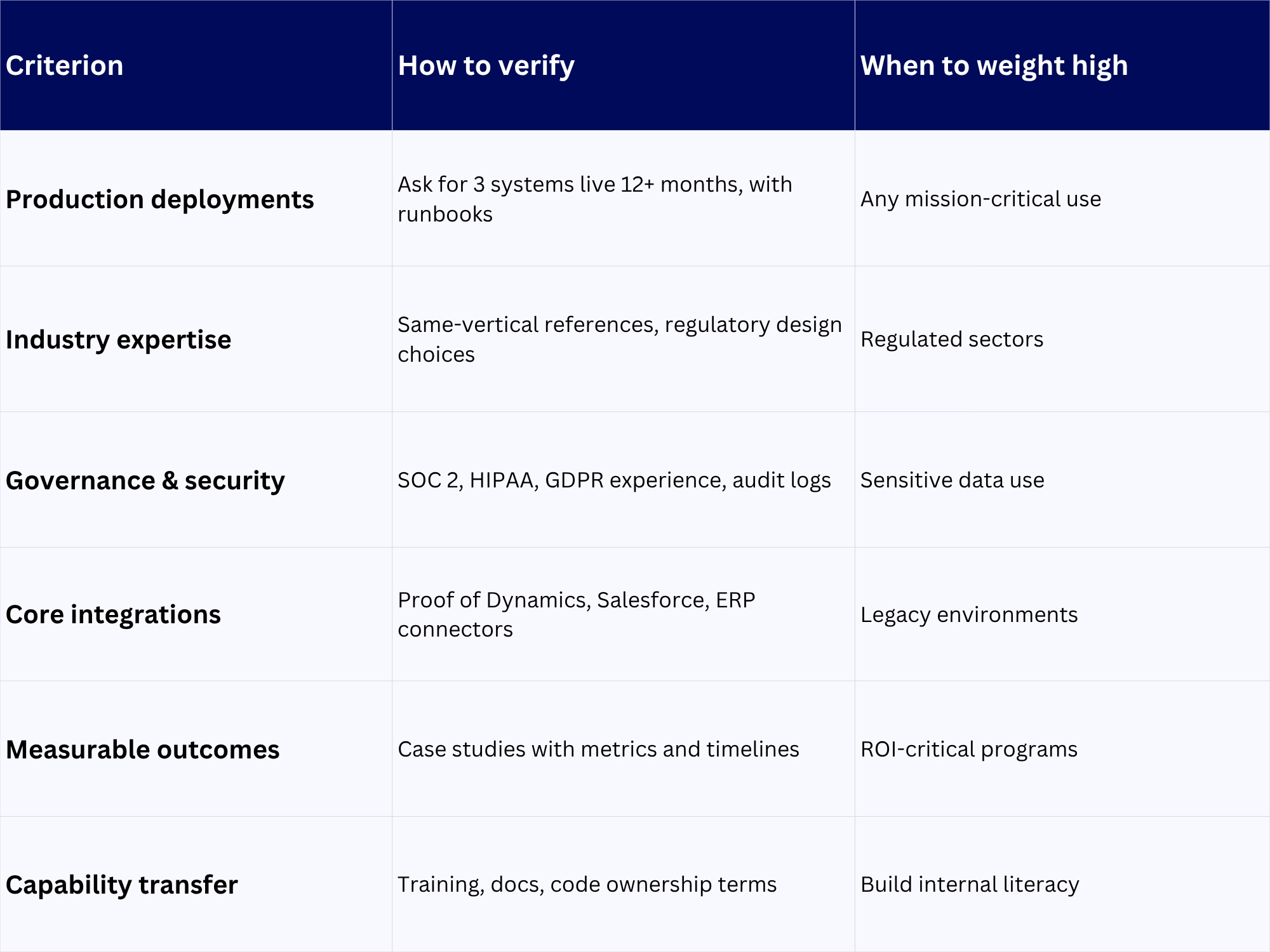
Use this table to anchor verification steps and weighting cues.
Checklist quick-reference
1. They Build Production Systems, Not Just Strategy Decks
Prototype success does not predict production reliability. Up to 95% of enterprise GenAI pilots show no clear ROI, a sign that many efforts never cross the pilot-to-production gap Fortune.
Demand architecture fluency, not just prompt fluency. Production systems must handle variable load, latency, rate limits, fallback chains, validation, and audit trails Last Rev.
Questions to ask:
- Show me three production systems you deployed that are still running 12+ months later. Provide runbooks and monitoring screenshots.
- What have you broken in production, and how did you fix it to prevent recurrence Last Rev?
- How do you route traffic across models, and what are your deterministic checks before outputs hit users?
Red flag: only demos or testimonials without metrics or operational detail.
CT Labs focuses on deployable solutions with prebuilt, governed agents and success metrics defined from day one CT Labs.
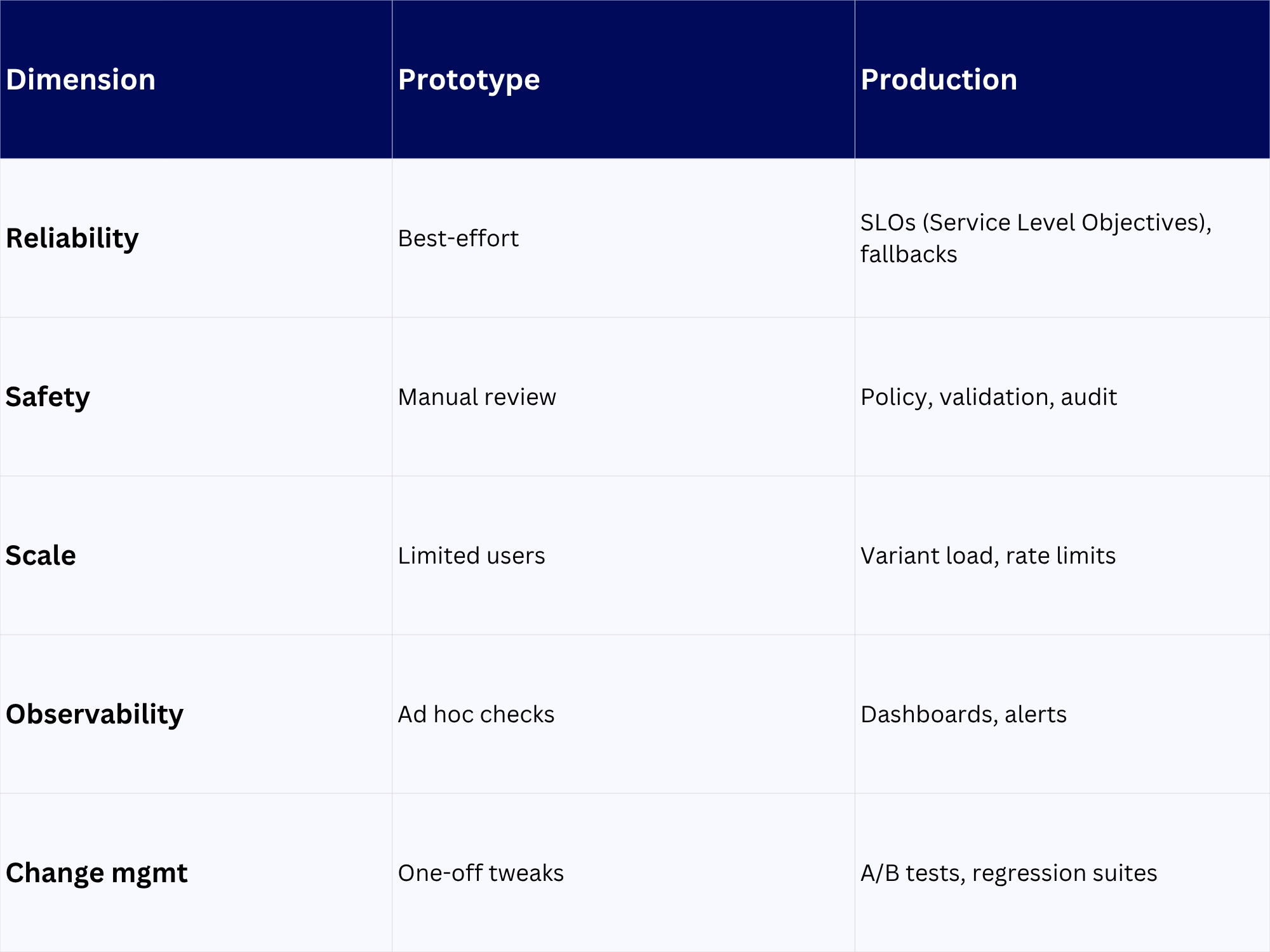
Prototype vs production, at a glance
2. Industry-Specific Experience and Domain Expertise
Generic AI skill is not enough. Domain constraints shape data, workflows, and compliance. Specialized boutiques deliver first value in 4 to 12 weeks, far faster than 12 to 24 months typical of large programs Dan Cumberland Labs.
A major red flag is the claim, "we work with all industries", which signals shallow domain depth Dan Cumberland Labs. Mid-sized firms also need partners who understand legacy realities and budgets Xcelacore.
Questions to ask:
- Which regulatory rules shaped your design in our sector, and how did you verify compliance in production?
- Can I speak to two customers in my vertical about post-deployment outcomes?
- How did you handle domain-specific data quality or labeling issues in similar projects?
3. Technical Excellence Across Your Required AI Domains
Technical excellence shows up in architecture and testing discipline. Ask the team to whiteboard a production design with guardrails, fallbacks, evaluation, and monitoring Last Rev. Cross-functional skill across cloud, data, and analytics ecosystems is table stakes Centric Consulting.
Look for documented evaluation methods: regression testing suites, AI observability, and A/B testing protocols. Expect clarity on when to swap models, re-prompt, or fail closed.
Questions to ask:
- Walk me through your evaluation harness. What metrics do you track before and after releases?
- How do you log prompts, outputs, and human feedback to support audits?
- Which failure modes did your last system encounter, and how did monitoring catch them early Last Rev?
4. Proven Track Record with Verifiable, Measurable Results
Move beyond testimonials. Ask for quantified outcomes tied to business metrics and timelines. Deep partnerships that combine tooling and experienced delivery succeed about 67% of the time, versus about 33% for purely internal builds Fortune.
Centric emphasizes case studies that show measurable outcomes and integration into core systems Centric Consulting. CT Labs tracks value for governed, production-scale AI CT Labs.
Questions to ask:
- What was the measured ROI at 3, 6, and 12 months post-deployment, and how was it calculated?
- Share the architecture and runbooks from a system that improved a KPI, along with incident history.
- Which adoption metrics did you track, and what changed after training?
5. Capability Transfer Over Dependency Creation
The right partner builds your muscle, then gets out of the way. Effective knowledge transfer multiplies organizational capability and reduces reliance on individual specialists Skill Studio.
Expect documentation, training, paired programming, and clear ownership of code and infrastructure. CT Labs formalizes capability building with governance docs, evaluation criteria, and explicit transition milestones CT Labs.
Questions to ask:
- What training and documentation will my team receive to run and evolve the system independently?
- Who owns the code, data pipelines, and model prompts at the end of the engagement?
- How do you ensure we can retrain, re-prompt, and redeploy without you?
6. Comprehensive Service Offerings: Strategy Through Deployment
Strategy without delivery does not move KPIs. Many global firms produce roadmaps, but fewer build and operate production systems at scale. Specialized boutiques often take clients from assessment to deployment while preserving control and ownership TFSF Ventures Dan Cumberland Labs.
CT Labs operates strategy through delivery with governed agentic workflows that target measurable ROI CT Labs.
Questions to ask:
- Who handles architecture, MLOps (Machine Learning Operations), data engineering, and change management, and how do these teams work together?
- Show the post-launch optimization plan for month two and month six.
- How do you avoid gaps when handing work from strategy teams to builders?
7. Data Security, Privacy, and Compliance Standards
Security and privacy sit at the heart of ROI for GenAI. Two-thirds of enterprises cite cybersecurity, privacy, and data quality as key inhibitors of ROI CIO Dive.
Production systems should support immutable logging and align with frameworks like SOC 2, HIPAA, or GDPR where applicable Last Rev. Finance and healthcare require bias auditing, explainability, and human oversight YouTube.
Questions to ask:
- How do you segregate sensitive training data and enforce least-privilege access?
- Which compliance audits have your teams supported, and what evidence can you share?
- How do you detect and remediate privacy incidents in production?
8. Integration Capabilities with Existing Systems
AI value appears when it plugs into your core platforms and processes. Partners should show depth with ecosystems like Microsoft Dynamics and Salesforce, along with data and cloud expertise Centric Consulting.
Mid-market realities often include mixed legacy stacks. Generalists who ignore these constraints propose brittle architectures Xcelacore.
Questions to ask:
- What integration patterns did you use to connect AI to our CRM, ERP, or data lake in similar projects?
- Share an example where you stabilized a legacy API or message bus under AI-driven load.
- How do you design idempotent, resilient connectors that degrade gracefully?
9. Scalability and Future-Proofing Approach
Design for growth and change. Production systems must handle variable load, latency, and rate limits and use fallback chains across models to sustain reliability Last Rev.
Strong partners treat AI as an evolving product with A/B testing and regression suites. CT Labs builds reusable components designed for production use and iterative improvement CT Labs.
Questions to ask:
- How do you decide when to switch models or prompts, and how is this tested safely?
- What are your horizontal scaling and caching strategies under peak demand?
- How do you isolate and roll back defective changes without downtime?
10. Transparent, ROI-Focused Pricing Models
Insist on pricing that maps to measurable outcomes. Specialized boutiques charge 40 to 60% less than Big 4 engagements and deliver first value in 4 to 12 weeks, not 12 to 24 months Dan Cumberland Labs.
Ask for unit economics, such as cost per AI transaction, and milestones tied to acceptance criteria Last Rev. CT Labs runs an ROI-first mandate that tracks value explicitly CT Labs.
Questions to ask:
- Provide a milestone plan with deliverables, acceptance tests, and exit criteria tied to KPIs.
- What is the expected cost per transaction at go-live and after optimization?
- Show how scope changes are governed to prevent creep.
11. They Start with Your People, Not the Technology
Human factors make or break AI programs. Common failure modes include poor problem selection and underestimating implementation difficulty, which are addressable through communication and change management University of Queensland.
CT Labs starts with business objectives and adoption planning, then selects technology to serve those goals CT Labs.
Questions to ask:
- How will you assess organizational readiness and stakeholder incentives before design?
- What adoption metrics and training paths will you implement for end users and managers?
- How will you handle role changes and govern human-in-the-loop decisions?
12. Measurable Success Defined Before Starting
Set KPIs early to avoid the measurement gap that sinks most efforts. Over 80% of AI projects fail to deliver measurable impact, which underscores the need for upfront success metrics and baselines Pertama Partners.
Centric prioritizes measurable outcomes in case studies, and CT Labs insists on success metrics and ROI tracking before kickoff Centric Consulting CT Labs.
Questions to ask:
- What KPIs will this system move, how will we baseline them, and what targets are credible in 90 days?
- Which data sources feed the KPI dashboard, and how do we audit the calculations?
- How will we attribute impact and separate model gains from process changes?
13. Communication, Collaboration, and Cultural Fit
Strong delivery requires leadership support and cultural alignment. Investing in communication and change management is a top recommendation to avoid failure University of Queensland.
Multidisciplinary teams that blend engineering, data, and change management create better conditions for adoption Dan Cumberland Labs.
Questions to ask:
- Who will I work with daily, and how often will we review risks and decisions?
- What is your escalation path, and how do you report status to executives and operators?
- Share an example of resolving cross-functional conflict on a prior AI program.
14. Post-Deployment Support and Continuous Improvement
Ask for the month-two and month-six optimization plan. Production systems need monitoring for quality, latency, error rates, and cost per transaction, with procedures for prompt or concept drift and model retraining Last Rev YouTube.
Expect operational documentation and clear escalation paths at a minimum. CT Labs provides governance docs, observability, and adoption support for stable operations CT Labs.
Questions to ask:
- Which production metrics are on your dashboards, and who owns each alert?
- How do you detect drift, and what is the retraining or re-prompting cadence?
- What SLA and response times do you commit to in support?
15. Innovation Leadership and Research Orientation
Innovation should be safe and measurable. Firms that treat AI as a product use A/B testing to route small amounts of traffic to new models or prompts, then compare outcomes before full rollout Last Rev.
Balance is key. Directionally, look for partners who can test emerging capabilities without risking stability or compliance.
Questions to ask:
- How do you test new models or prompts in production without risking users?
- What evidence shows the innovation benefited key KPIs before scaling?
- How do you roll back experimental changes quickly if quality drops?
Critical Red Flags: Warning Signs to Avoid
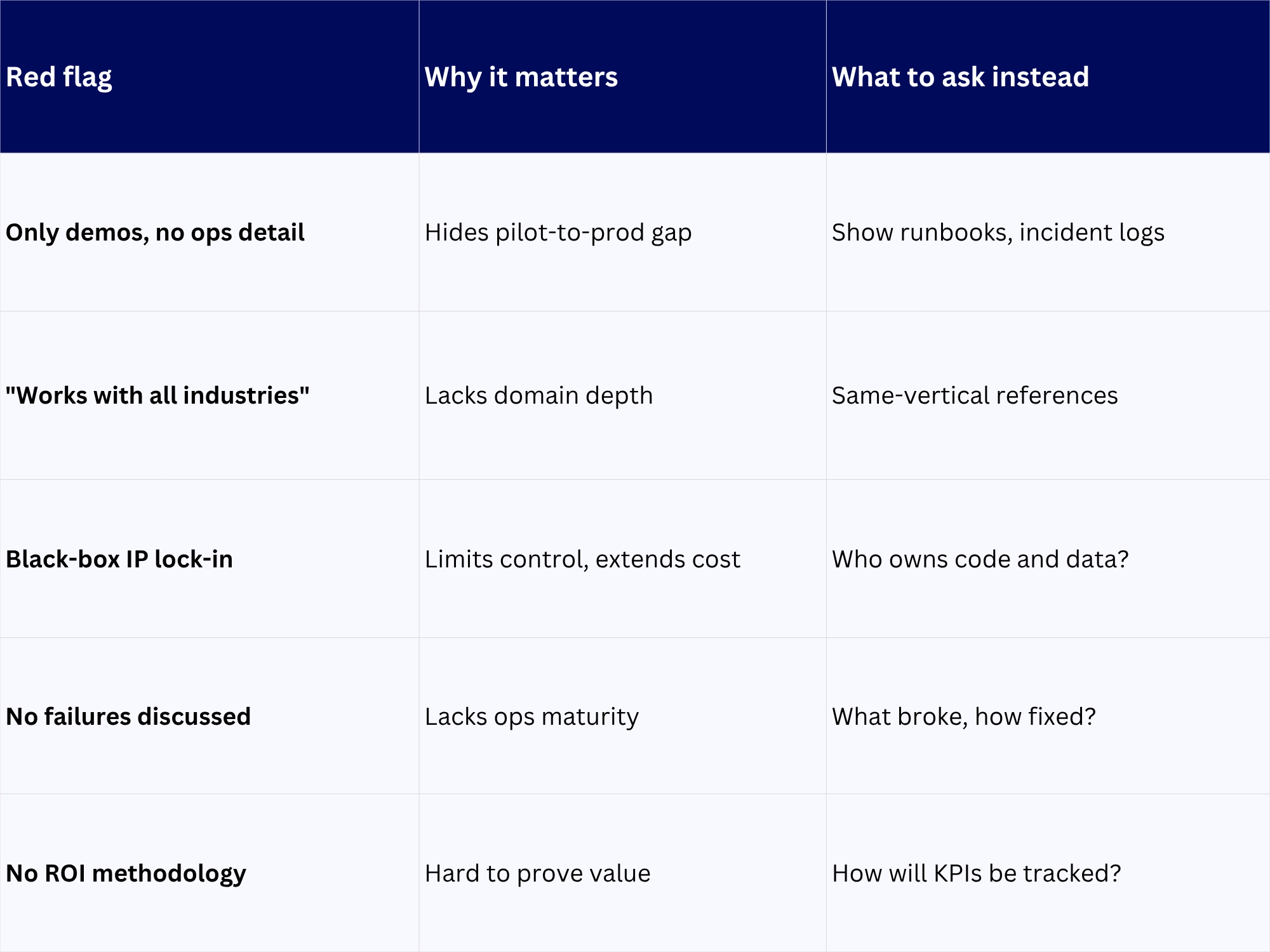
Be cautious with generic claims and black-box offerings. A major red flag is the line, "we work with all industries", which signals shallow domain depth Dan Cumberland Labs. Also avoid firms that cannot describe failures and fixes, which suggests a prototype-first orientation Last Rev.
Look for operational artifacts like runbooks and monitoring. Lack of these is a strong indicator that the team has not delivered production systems.
Red flags checklist
Consultant Types: Big 4 vs. Boutique vs. Specialist Firms
Each type has trade-offs. Specialized boutiques charge 40 to 60% less than Big 4 and deliver first value in 4 to 12 weeks, not 12 to 24 months Dan Cumberland Labs. Many global firms emphasize strategy, while boutiques focus on build-and-operate with code ownership and pass-through of infrastructure TFSF Ventures.
Match partner type to your risk, budget, and timelines. Prioritize implementation maturity regardless of logo.
Making Your Final Decision: Evaluation Framework
Use the checklist as both an internal alignment tool and an external scoring aid. Internally, agree on priorities, risk tolerances, and must-have evidence. Externally, require architecture diagrams, governance artifacts, integration proofs, and case study metrics to support scoring Centric Consulting Last Rev Dan Cumberland Labs.
Reference checks should validate post-deployment stability, adoption, and ROI. Build consensus by comparing verified artifacts, not slide claims.
How CT Labs Meets These Selection Criteria
CT Labs is workflow-first. We deliver governed agentic workflows with security and access patterns, observability, and adoption support, and we launched with more than 30 prebuilt agents for functions like intake and claims resolution CT Labs.
Our ROI-first mandate defines success metrics before kickoff, tracks unit economics, and prioritizes capability transfer. Clients retain code and infrastructure control with runbooks, training, and clear transition milestones CT Labs.
FAQ: Choosing the Right AI Consulting Firm
Why do most AI projects fail?
Most AI projects fail due to organizational and architectural issues, not algorithmic limitations. The pilot-to-production gap is a major cause, where projects stall before reaching operationalization and measurable impact Pertama Partners Fortune.
How long does an AI consulting project take to show value?
Specialized boutiques deliver first value in 4 to 12 weeks, which is much faster than the 12 to 24 months typical of large programs Dan Cumberland Labs.
What is the difference between an AI prototype and a production system?
A prototype is a proof-of-concept with limited reliability, safety, scale, and observability. A production system is built for reliability (with SLOs), robust safety controls, scalable architecture, and continuous monitoring Last Rev. See the "Prototype vs production, at a glance" table above for a comparison.
Conclusion: From Selection to Successful Partnership
Use this 15-point checklist during shortlisting, RFPs (Requests for Proposal), and live whiteboarding. The difference between a polished demo and a production system is large, which is why so many pilots fail to reach ROI (Return on Investment) Fortune.
Firms that build deep partnerships and combine tools with delivery succeed about 67% of the time, compared with about 33% for purely internal builds Fortune. Download the PDF checklist to align stakeholders, then schedule structured consultant interviews that require architecture diagrams, governance artifacts, and measurable outcome plans. Your selection will shape speed to value, risk profile, and long-term capability.
Conclusion
The right AI partner builds production systems that measurably improve KPIs, integrates safely with your stack, and transfers capability to your team. Anchor your vendor choice to verifiable artifacts, not promises: production runbooks, governance evidence, integration proofs, and outcome metrics. Partnerships that combine tooling and deep delivery succeed about 67% of the time, versus about 33% for purely internal builds Fortune.
Next steps: use the 15-point checklist to score current contenders, run a live architecture whiteboard with your finalists, and require success metrics before contract signature. If you want a workflow-first, ROI-focused approach with clear capability transfer, reach out to CT Labs to review a production blueprint and sample runbooks.