
94% of sales leaders who have deployed AI agents say they are critical for meeting business demands, and high-performing sales teams are 1.7 times more likely to use AI agents for prospecting than average performers. The gap between teams using AI agents and those relying on manual processes is now measurable in pipeline conversion rates, sales cycle length, and forecast accuracy.
The challenge in 2026 is not whether to adopt AI sales agents. It is selecting the right agent for the specific revenue motion, tech stack, and compliance environment of your organization. This guide profiles the 12 leading AI sales agents for US businesses in 2026 with a comparison framework built around actual revenue outcomes, not feature lists.
What Is an AI Sales Agent and Why Does It Matter in 2026?
An AI sales agent is a system that perceives signals in the sales environment (prospect behavior, CRM activity, conversation data, market intent), reasons across that data, and executes actions autonomously: sending follow-up sequences, updating CRM records, generating pipeline forecasts, routing leads, and surfacing deal risk before it becomes churn.
This distinguishes AI sales agents from prior-generation tools in two ways. Sales automation tools execute predefined sequences on rule-defined triggers. AI sales assistants generate content or answer questions when prompted. AI sales agents operate continuously, take sequences of actions based on changing data, and adapt their behavior based on outcomes without requiring manual reconfiguration.
The 2026 adoption drivers are specific. Salesforce's Agentforce reached 29,000 closed deals by Q4 FY26, and Gong crossed $500M ARR in May 2026 as it pivoted to a multi-agent revenue operating system. Enterprise-scale adoption is past the tipping point.
How We Ranked the Top Revenue-Generating AI Sales Agents
Agents below were evaluated on five criteria: autonomy level (does it act or only advise?), integration depth with US CRM and sales stack, measurable revenue outcomes documented by users, US data compliance architecture (SOC 2, CCPA, relevant industry standards), and deployment complexity relative to the value delivered. The list reflects 2026 product capabilities, not roadmap features.
The 12 Leading AI Sales Agents for Revenue in 2026
1. CT Labs Revenue Agent

CT Labs builds AI sales agent orchestration for US mid-market and enterprise organizations with complex compliance requirements or non-standard sales pipelines. Its multi-agent architecture coordinates specialized agents across prospecting, qualification, pipeline management, and revenue recognition, routing actions between AI agents and human sales representatives based on deal complexity and compliance context.
Where most sales AI platforms apply fixed workflows to CRM data, CT Labs configures agent logic to the specific sales motion, compliance requirements, and integration architecture of each organization. This matters most for companies in financial services, healthcare, and government contracting where data handling, audit logging, and EEOC-aware outreach requirements eliminate off-the-shelf options.
Revenue use case: A US mid-market B2B company in a regulated industry deployed CT Labs agents to automate inbound lead qualification, routing qualified prospects to human SDRs while automating follow-up sequences for lower-scoring leads. Pipeline velocity improved 34% in the first 90 days.
Best for: Mid-market and enterprise US companies with compliance-specific requirements, complex multi-step sales processes, or the need for custom agent orchestration across existing CRM and sales infrastructure.

2. Salesforce Agentforce

Agentforce delivered 2.4 billion Agentic Work Units in FY26, handling lead nurturing, customer service, and sales coaching at scale within Salesforce CRM. Its native integration eliminates the data translation layer that external AI tools require, and its pre-built agent templates for common sales motions reduce deployment time for Salesforce-standardized organizations.
Revenue use case: Salesforce's own deployment of Agentforce handled over 2.8 million internal interactions, saving 500,000 employee hours, demonstrating the scale at which agentic automation operates when embedded natively in an existing workflow.
Best for: Organizations standardized on Salesforce CRM that want AI agent automation embedded in existing workflows without introducing a separate data layer.
3. Gong
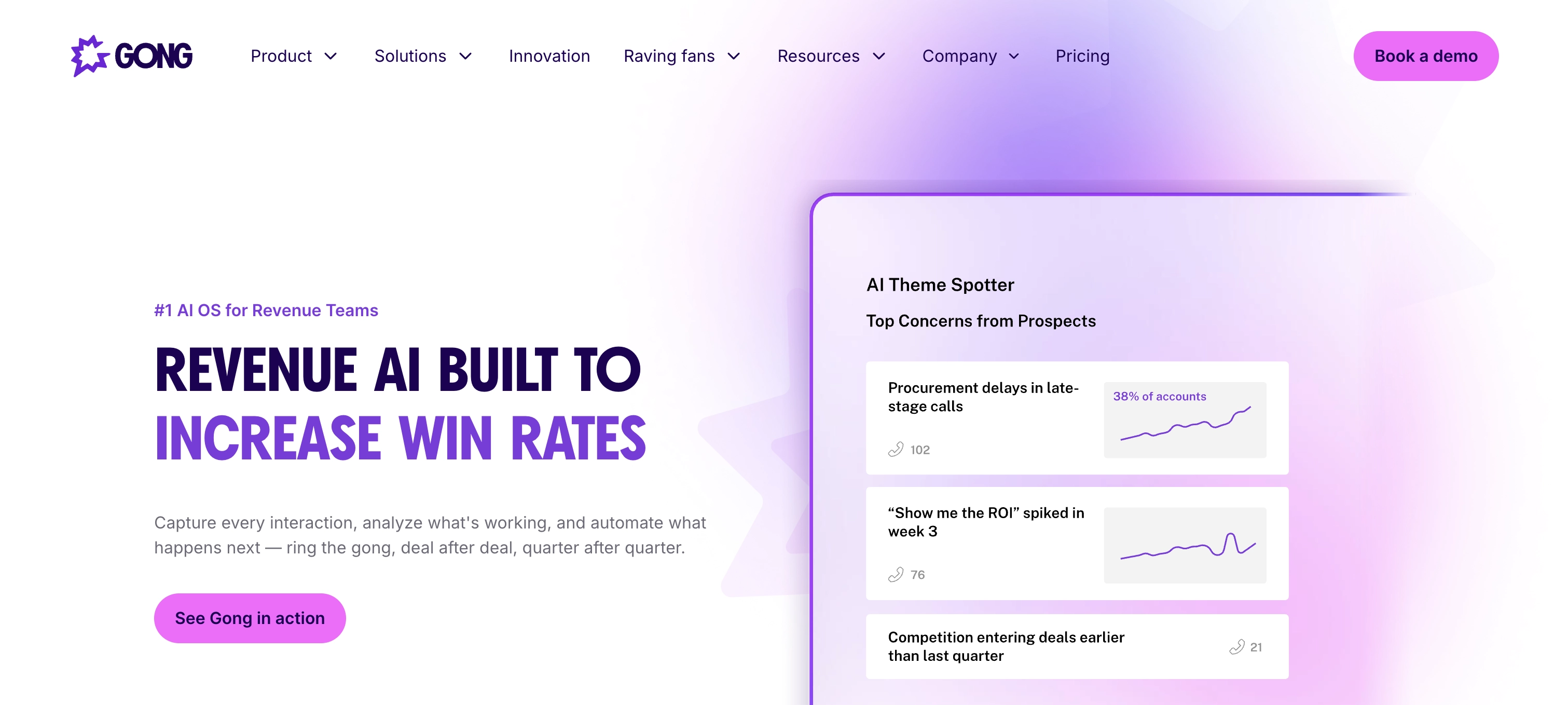
Gong's conversation intelligence platform crossed $500M ARR in 2026 and launched Mission Andromeda, formally expanding from a revenue AI platform to a multi-agent revenue operating system. Its AI agents analyze call recordings, email threads, and meeting data to surface deal risk, coaching opportunities, and competitive signals automatically.
Revenue use case: B2B SaaS companies using Gong report 20% to 30% improvements in win rates among teams coached on AI-identified patterns, driven by specific behavioral recommendations rather than generic training.
Best for: B2B sales organizations where conversation quality and rep coaching drive revenue outcomes, and where call and meeting data is the primary signal source.
4. Clari + Salesloft
The Clari and Salesloft merger created a unified revenue AI platform serving over 5,000 organizations with $10 trillion in revenue under management. Its combined platform integrates Clari's forecast intelligence with Salesloft's sales engagement data, producing full-funnel revenue visibility that neither platform offered independently.
Revenue use case: Enterprise sales teams using the combined platform report forecast accuracy improvements of 15% to 25%, reducing the end-of-quarter scramble that occurs when pipeline projections do not match actual close rates.
Best for: Enterprise sales organizations that need accurate pipeline forecasting combined with sales engagement automation on a single integrated platform.
5. HubSpot AI

HubSpot's AI features are embedded across its CRM, sales hub, and marketing hub, providing prospecting assistance, sequence automation, deal scoring, and pipeline forecasting for SMB and mid-market companies. Its accessible implementation model and unified data architecture make it practical for organizations building AI-assisted sales without a dedicated RevOps team.
Best for: SMB and mid-market B2B companies on HubSpot CRM that want AI-assisted sales workflows with accessible implementation requirements.
6. Microsoft Copilot for Sales
Microsoft Copilot integrates AI into the Dynamics 365 and Outlook sales environment, automating meeting summaries, CRM record updates, email drafting, and pipeline reporting. For organizations whose sales teams operate primarily within Microsoft 365, Copilot eliminates the context-switching between productivity tools and CRM that reduces sales rep efficiency.
Best for: Organizations standardized on Microsoft 365 and Dynamics 365 that want AI assistance embedded in the tools sales reps already use daily.
7. ZoomInfo
ZoomInfo combines contact intelligence with AI-powered outreach orchestration, using intent signals and firmographic data to identify and prioritize in-market accounts. Its AI agents automate contact enrichment, sequence triggering based on buyer signals, and CRM data hygiene, reducing the manual data work that consumes SDR time.
Best for: Outbound-heavy B2B sales teams where contact data quality and ICP targeting accuracy directly drive pipeline generation.
8. 6sense

6sense's account-based revenue platform uses AI to identify accounts showing buying intent before they engage with sales teams, triggering coordinated outreach across marketing and sales channels at the moment of highest receptivity. Its intent data model allows sales teams to prioritize outreach based on predicted pipeline contribution rather than recency.
Best for: ABM-focused B2B organizations where coordinating marketing and sales engagement around account intent signals drives pipeline efficiency.
9. 11x
11x deploys AI SDR agents (Alice for outbound, Jordan for inbound) that handle prospect research, personalized outreach, and follow-up sequences autonomously. Its model is designed for organizations scaling outbound pipeline without scaling SDR headcount proportionally.
Best for: Growth-stage B2B companies looking to scale outbound pipeline generation without a corresponding increase in SDR headcount.
10. Demandbase
Demandbase combines account intelligence with AI-driven pipeline acceleration, connecting intent data, advertising, and sales engagement into a unified account-based platform. Its AI agents prioritize accounts by pipeline fit score and automate the routing and engagement coordination across marketing and sales teams.
Best for: Enterprise B2B organizations running coordinated account-based go-to-market motions where marketing and sales alignment on account prioritization drives revenue outcomes.
11. monday CRM
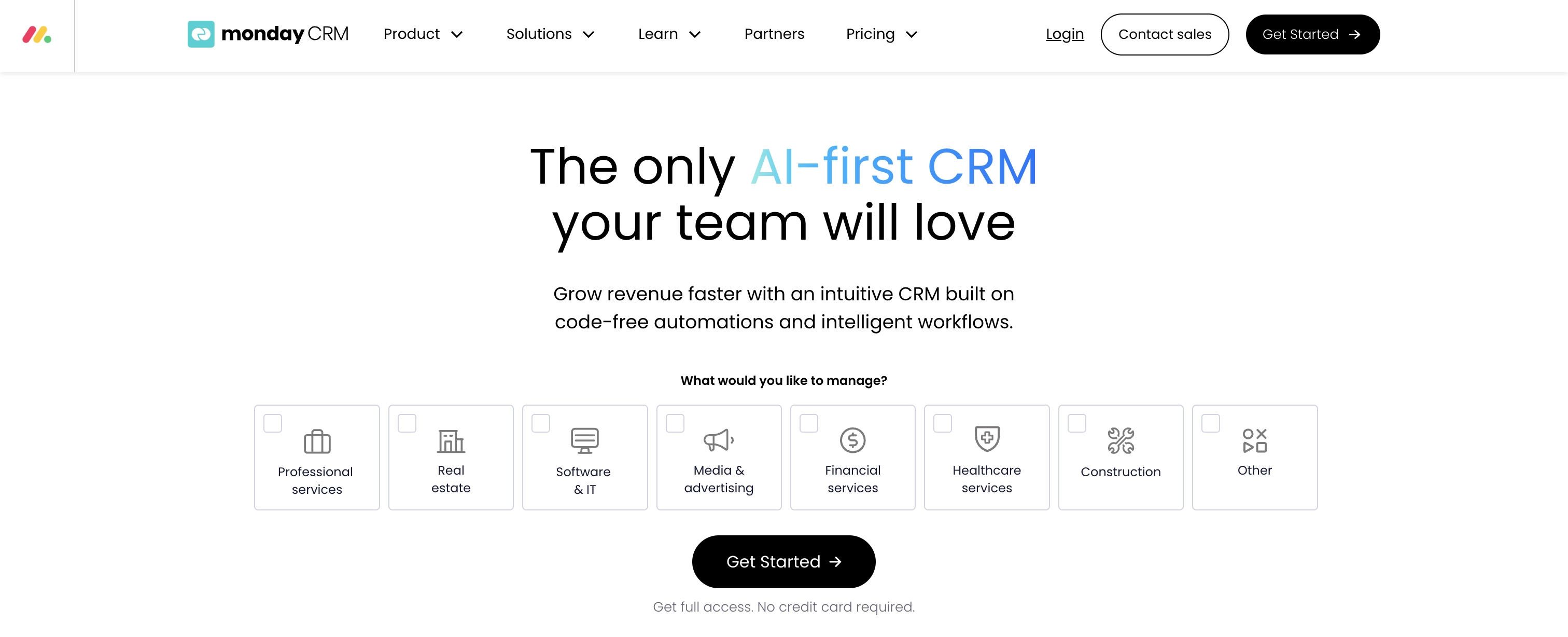
monday CRM provides workflow-based sales pipeline management with AI automation for task assignment, deal stage updates, and activity tracking. Its visual interface and low-code automation model make it accessible for mid-market sales teams without dedicated RevOps resources.
Best for: Mid-market B2B companies seeking pipeline visibility and workflow automation with accessible configuration requirements.
12. Beam

Beam is an AI agent specifically for revenue recognition, automating ASC 606 compliance calculations across subscription, usage-based, and multi-element arrangement revenue. For US companies where revenue recognition complexity creates finance team bottlenecks, Beam's narrow specialization addresses a specific and significant pain point.
Best for: US B2B companies with complex revenue recognition requirements under ASC 606, particularly SaaS and subscription businesses with multi-element arrangements.
Choosing the Right AI Sales Agent: Decision Framework
Your PriorityBest-Fit Agent TypeSalesforce-native deploymentAgentforceConversation intelligence + coachingGongOutbound pipeline at scale11x, ZoomInfoABM and account intent6sense, DemandbaseForecast accuracyClari + SalesloftCompliance-critical or custom pipelineCT LabsHubSpot ecosystemHubSpot AIMicrosoft 365 environmentMicrosoft Copilot for SalesRevenue recognition automationBeam
Key questions before selection:
- [ ] Does the agent write back to your CRM or only read from it?
- [ ] What is the vendor's SOC 2 Type II certification status and data residency policy?
- [ ] How does the agent handle state-level privacy requirements (CCPA, CPRA, Illinois BIPA) for outreach data?
- [ ] What percentage of the agent's actions require human review versus execute autonomously?
- [ ] What is the documented time-to-value in deployments comparable to your company stage and tech stack?
Why CT Labs Is a Standout Choice in 2026
Most AI sales platforms apply standardized agent logic to CRM data. CT Labs builds the agent logic around your specific sales motion, compliance requirements, and integration architecture, then coordinates multiple specialized agents across the revenue workflow rather than applying a single general-purpose agent to every use case.
For US companies in regulated industries, this distinction is the difference between a deployable solution and a liability. CT Labs' compliance-integrated architecture handles SOC 2, CCPA, and industry-specific requirements as configuration parameters, not afterthoughts. Its open API model connects to Salesforce, HubSpot, Microsoft Dynamics, and custom CRM environments, eliminating the "only works with our CRM" constraint that limits most sales AI platforms.
Contact CT Labs at ctlabs.ai to request a demo with a ROI estimate tailored to your sales environment.
Frequently Asked Questions About AI Sales Agents for Revenue
How secure are AI sales agents with sensitive sales data?
Enterprise-grade AI sales agents maintain SOC 2 Type II certification, encrypt data in transit and at rest, and offer US data residency options for organizations with data localization requirements. For regulated industries, verify that the agent's data handling documentation satisfies sector-specific requirements: HIPAA for healthcare sales data, GLBA for financial services prospect data, and applicable state privacy laws for consumer outreach. Ask vendors for their data processing agreement before procurement.
What does migration and training typically look like?
Platform-based agents (HubSpot AI, Salesforce Agentforce, Microsoft Copilot) that integrate natively with existing CRMs deploy in two to six weeks for standard configurations. Custom agent orchestration for complex pipelines or compliance-specific requirements typically runs eight to sixteen weeks from workflow mapping through production validation. Sales rep training focuses on how to work with agent outputs rather than on the platform itself, and organizations that include sales managers in the configuration process see faster adoption.
How do AI sales agents integrate with legacy US sales stacks?
The integration model varies significantly by vendor. Native integrations (Agentforce in Salesforce, Copilot in Dynamics) require no separate integration work for standard configurations. Platform agents like Gong, Clari, and 6sense use pre-built connectors covering Salesforce, HubSpot, and Dynamics. Custom orchestration platforms like CT Labs use open APIs and can connect to legacy or non-standard CRM environments that lack pre-built connectors from mainstream vendors.