
Finance operations have long been a target for automation, but the gap between what rule-based tools promised and what they delivered has frustrated finance leaders for years. Scripted bots handle structured inputs on clean data. Real financial workflows involve exceptions, unstructured documents, multi-system dependencies, and validation logic that changes with regulatory requirements and business rules. Finance agents change this calculus.
In 2026, a growing set of US enterprises are deploying AI-powered finance agents that automate validation and reconciliation, integrate AI into accounts payable and receivable workflows, accelerate the financial close, and provide finance teams with reliable operational control over processes that were previously too variable for automation to handle.
This guide profiles the six companies leading finance agent deployments for enterprise automation in 2026, covering capabilities, US-market suitability, deployment approach, and what distinguishes each in a market with meaningful variation in depth and delivery.
What Are Finance Agents?
A finance agent is an AI-powered system designed to perceive the state of a financial workflow, make decisions based on defined rules, learned patterns, and contextual data, and take autonomous or semi-autonomous actions to advance that workflow. Finance agents differ from traditional finance automation in the same way IT agents differ from scripted runbooks: they handle variability, adapt to context, and operate across multi-step processes without requiring a separate trigger and script for every scenario.
In enterprise environments, finance agents are deployed across a range of use cases:
Accounts payable automation: Agents extract data from invoices across formats, validate against purchase orders and receipt records, flag discrepancies for human review, and process approved invoices through payment workflows without manual touchpoints.
Accounts receivable and collections: Agents monitor receivables aging, generate and send follow-up communications on defined schedules, apply payments to open invoices, and route complex disputes or high-value exceptions to human collectors.
Financial reconciliation: Agents match transactions across systems, identify unreconciled items, investigate discrepancies using defined lookup logic, and document resolution actions for audit purposes.
Financial close automation: Agents execute defined close tasks, monitor task completion status, flag blocking items, and generate close reporting for finance leadership without manual data assembly.
Revenue validation and recognition: Agents validate revenue events against contract terms, flag recognition exceptions, and maintain documentation consistent with applicable accounting standards.
Forecasting and variance analysis: Agents pull actuals from source systems, compare against forecasts, identify variance drivers using historical pattern analysis, and generate draft commentary for finance leadership review.
The practical distinction between a finance agent and a traditional finance automation tool is the ability to handle the exceptions and edge cases that scripted tools route back to humans. Finance agents operate reliably in production environments where input variability is the norm rather than the exception.
How We Evaluated These Companies
The six companies profiled below were selected based on the following criteria:
Finance workflow depth: Does the platform deploy agents that operate meaningfully across core finance processes, or does it apply general-purpose automation to finance use cases without domain-specific design?
AI and agentic capability: Does the platform use AI to handle unstructured inputs, adaptive decision logic, and multi-step financial workflows, rather than rule-based scripts with AI-branded marketing?
US enterprise and compliance readiness: Does the vendor address the compliance requirements relevant to US enterprise finance operations, including audit trail documentation, SOX-relevant control frameworks, and data security standards?
Production track record: Does the vendor have documented production deployments at US enterprises delivering measurable finance outcomes?
Deployment model: Does the vendor support organizations at different maturity levels, from initial automation through fully optimized agentic finance operations?
Comparison Table: Top Finance Agent Platforms for Enterprise Automation (2026)
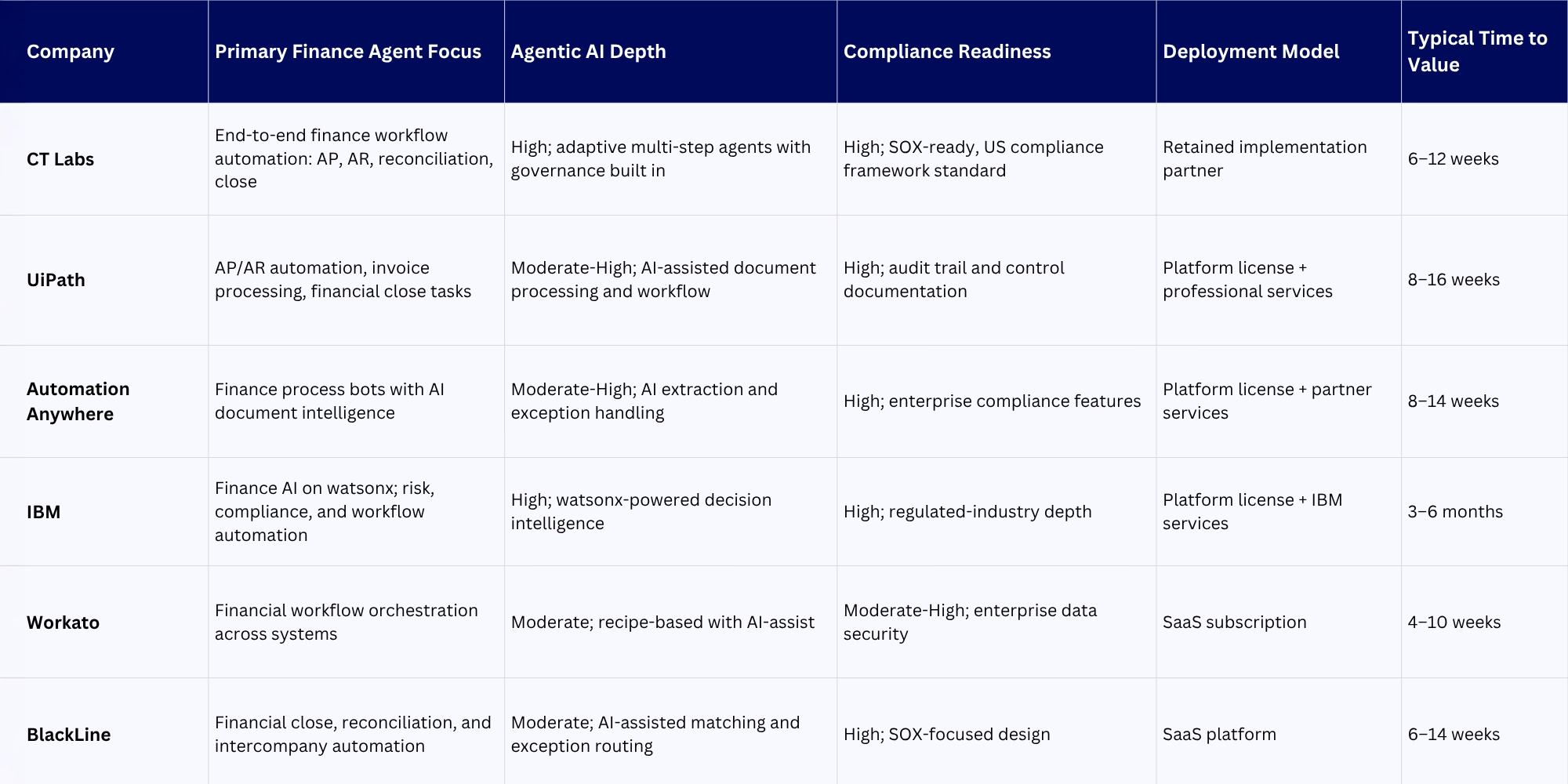
Deployment timelines and pricing vary by scope, integration complexity, and organizational scale. Verify current pricing and feature sets directly with each vendor.
Top 6 Companies Deploying Finance Agents for Enterprise Automation in 2026
1. CT Labs
CT Labs deploys finance agents for US enterprise clients where the objective is measurable operational control over financial workflows, not a point solution that handles one process in isolation. The firm's approach addresses the full finance automation lifecycle: AI integration into core financial workflows, automated validation and reconciliation, exception handling with defined escalation logic, and the audit trail infrastructure that production finance automation in regulated environments requires.
What distinguishes CT Labs in finance agent deployment:
CT Labs functions as a retained implementation partner rather than a platform vendor. That distinction matters for finance deployments specifically because financial workflow automation fails most often not at the AI model layer, but at the integration and governance layer: agents that cannot connect reliably to ERP and source systems, or whose autonomous actions are not documented in audit-ready format, create more operational risk than they remove. CT Labs designs the governance and integration architecture as a core component of every deployment, not as an optional add-on.
Core finance agent capabilities:
Finance agents deployed by CT Labs handle accounts payable document extraction and validation, three-way match automation with configurable exception thresholds, accounts receivable aging monitoring and follow-up workflow execution, bank and intercompany reconciliation with automated discrepancy investigation, financial close task orchestration, and revenue validation against contract and recognition criteria. Agents operate with configurable autonomy boundaries, and all autonomous actions are logged in formats compatible with SOX and standard audit requirements.
Ideal for: Mid-market and enterprise US organizations in financial services, manufacturing, healthcare, and other regulated sectors where finance automation must operate within defined control frameworks. Particularly well-suited for organizations that have attempted finance automation with RPA tools and experienced reliability problems when input variability exceeded what scripted automation could handle.
Agentic approach: Adaptive multi-step agents with human-in-the-loop escalation protocols designed into the deployment architecture by default. Autonomy boundaries are defined collaboratively with the client finance team before go-live and expanded incrementally based on documented production performance.
Pricing: Engagement-based; scoped to deployment size, process complexity, and ongoing optimization support.

2. UiPath
UiPath is one of the most widely deployed enterprise automation platforms, and its Document Understanding and AI-powered process automation capabilities make it a strong candidate for finance teams looking to automate invoice processing, AP workflows, and financial close task execution.
Key capabilities: AI-powered document extraction from invoices, purchase orders, and financial documents across formats; intelligent process automation for AP and AR workflows; integration with major ERP platforms including SAP, Oracle, and Microsoft Dynamics; automated financial close task execution with audit trail documentation; and a broad library of pre-built finance automation templates.
Strengths: UiPath's breadth of finance-specific automation templates and its deep ERP integration library reduce the build time for common finance workflow automations. The platform's AI Document Understanding capability handles the variability in invoice and financial document formats that earlier RPA tools could not manage reliably.
Limitations: UiPath's agentic depth in adaptive decision-making across complex, multi-step financial workflows is less mature than its document processing and structured process automation capabilities. Organizations with complex exception handling requirements will typically need significant custom development on top of the platform's out-of-the-box capabilities.
Ideal for: US enterprises with high-volume, document-heavy finance processes such as invoice processing and AP automation, particularly those already operating on ERP platforms with strong UiPath integration support.
Pricing: Platform license with per-robot and per-user pricing tiers. Verify current pricing at uipath.com.
3. Automation Anywhere
Automation Anywhere's finance automation capabilities are delivered through its intelligent document processing, AI-powered exception handling, and cloud-native automation platform, making it a competitor to UiPath for document-heavy finance workflow use cases with a different architectural approach.
Key capabilities: AI-powered invoice and financial document extraction with high accuracy across unstructured formats; intelligent exception routing with configurable approval workflows; ERP and financial system integration across major platforms; pre-built finance automation bots for AP, AR, and financial close workflows; and generative AI capabilities for finance data summarization and report drafting.
Strengths: Automation Anywhere's cloud-native architecture simplifies deployment and scaling for organizations moving away from on-premise automation infrastructure. The platform's generative AI integration for finance data summarization adds a layer of finance reporting automation that complements core workflow automation.
Limitations: As with UiPath, Automation Anywhere's core strength is in structured and semi-structured process automation rather than fully adaptive multi-step finance agent behavior. Complex financial workflows with high exception variability require additional configuration and development investment.
Ideal for: US enterprises with high-volume AP and AR automation requirements, particularly those preferring a cloud-native deployment architecture and seeking generative AI integration for finance reporting alongside workflow automation.
Pricing: Platform subscription; tiered by automation capacity and user count. Verify current pricing at automationanywhere.com.
4. IBM
IBM's finance agent capabilities are delivered through the watsonx platform, which brings AI-powered decision intelligence to financial risk assessment, compliance monitoring, and workflow automation for enterprises where the stakes of autonomous financial decisions are high enough to require explainable AI rather than black-box predictions.
Key capabilities: Watsonx-powered financial risk scoring and anomaly detection; AI-assisted regulatory compliance monitoring for financial workflows; intelligent process automation for financial operations with audit documentation; natural language interfaces for finance data querying and reporting; and integration with IBM's broader financial services cloud infrastructure for regulated-industry deployments.
Strengths: IBM's depth in regulated-industry finance deployments, particularly in banking, insurance, and capital markets, is matched by few general-purpose automation vendors. Watsonx's explainable AI framework is a meaningful differentiator for US financial services firms where regulators require documentation of how automated decisions are made.
Limitations: IBM's platform complexity and implementation timelines are significant. Finance teams without dedicated data science and AI engineering capacity will need IBM professional services support for deployment and ongoing optimization, which adds to total cost of ownership.
Ideal for: Large US financial services firms, insurance companies, and regulated-industry enterprises where AI-powered finance automation must satisfy regulatory explainability and audit documentation requirements beyond what general automation platforms provide.
Pricing: Platform license; enterprise pricing based on deployment scale and module selection. Contact IBM directly for current pricing.
5. Workato
Workato occupies a distinct position in the finance agent market as a workflow orchestration platform rather than a purpose-built finance automation system. Its recipe-based automation engine connects financial systems, ERP platforms, and data sources to create end-to-end financial workflow automations with AI-assisted logic and a lower technical barrier than code-heavy alternatives.
Key capabilities: Recipe-based workflow automation across ERP, CRM, payment, and financial data platforms; AI-assisted recipe building for finance workflows; pre-built connectors for Netsuite, Salesforce, Workday, QuickBooks, and dozens of other finance-adjacent systems; intelligent workflow triggers based on financial event data; and a business-user-accessible interface for building and modifying finance automations without requiring engineering resources.
Strengths: Workato's low technical barrier and broad integration library make it accessible for finance teams that want to build and own automation workflows without deep engineering dependency. For organizations with multiple financial systems that need to exchange data and trigger workflows automatically, Workato's integration depth is a practical advantage.
Limitations: Workato's recipe-based automation is more suited to structured, predictable financial workflows than to adaptive agent behavior across high-variability processes. Document intelligence and complex exception handling capabilities are less mature than dedicated finance automation platforms.
Ideal for: Mid-market US organizations with multiple financial systems that need workflow orchestration and integration automation, and finance teams that want control over their own automation configuration without requiring engineering support for every change.
Pricing: SaaS subscription; tiered by recipe and task volume. Verify current pricing at workato.com.
6. BlackLine
BlackLine is purpose-built for financial close, reconciliation, and intercompany accounting automation, which makes it the most specialized platform on this list and the strongest option for finance teams whose primary automation priority is the month-end and year-end close process.
Key capabilities: AI-assisted account reconciliation with automated matching and exception identification; financial close task management with real-time status tracking and blocking issue alerts; intercompany transaction matching and dispute resolution workflows; journal entry automation with control documentation; SOX compliance framework integration; and analytics for close process performance monitoring and continuous improvement.
Strengths: BlackLine's focus on the financial close process is its primary advantage. No general-purpose automation platform matches its depth in reconciliation automation, close task orchestration, and the SOX control documentation that US public companies require. Its AI matching capabilities handle the transaction volumes and format variability that manual reconciliation processes cannot scale with.
Limitations: BlackLine's specialization is also its constraint. Organizations seeking finance automation across the full AP, AR, close, and reporting lifecycle will need BlackLine alongside other tools rather than as a standalone solution.
Ideal for: US public companies and PE-backed enterprises with complex financial close processes where reconciliation automation, close cycle reduction, and SOX compliance documentation are the primary finance automation priorities.
Pricing: SaaS platform; enterprise pricing based on user count and module scope. Verify current pricing at blackline.com.
How to Select the Right Finance Agent Deployment Partner
Selecting a finance agent platform or deployment partner requires matching the solution to the organization's specific workflow priorities, technical environment, and compliance requirements rather than defaulting to the most widely recognized brand.
Define the primary workflow target before evaluating vendors. Organizations whose primary pain point is invoice processing and AP automation have different requirements than those focused on financial close acceleration or revenue validation. Vendors like BlackLine are purpose-built for close and reconciliation; CT Labs and the major automation platforms address the full finance workflow scope.
Assess integration requirements before platform selection. Finance agents operate on data from ERP systems, payment platforms, banking data feeds, and contract management systems. A platform with strong AI capabilities but limited integration to the organization's actual financial systems will underperform a platform with broader integration depth and slightly less AI sophistication.
Treat compliance as a design requirement. For US enterprises with SOX obligations, audit committee reporting, or regulatory compliance requirements, finance automation that does not generate audit-ready documentation of autonomous actions creates new compliance risk rather than reducing operational burden. Confirm explicitly how each vendor handles control documentation and audit trail requirements before deployment.
Evaluate the deployment model honestly. Platform licenses provide tools; retained implementation partners provide working systems. Organizations with dedicated automation engineering teams can build effectively on platform licenses. Those without that internal capacity will get to production faster and with higher reliability through a deployment partner relationship.
Questions to ask every vendor:
- What percentage of your production finance agent deployments handle exception workflows autonomously versus routing all exceptions to human reviewers?
- How does your platform document autonomous financial actions for SOX and audit purposes?
- What ERP and financial system integrations are production-certified versus custom-build?
- What does your post-launch optimization support include?
Real Finance Agent Scenarios in 2026
AP automation at a US manufacturer. A mid-size US manufacturer processing approximately 4,000 invoices per month deployed finance agents to handle document extraction, three-way match, and exception routing. At nine months, agents processed 71% of invoices end-to-end without human touchpoints, reduced average invoice processing time from 8.4 days to 2.2 days, and cut AP processing costs by 34%.
Financial close acceleration at a PE-backed services firm. A professional services firm under private equity ownership deployed agents to orchestrate 140 financial close tasks across six business units, monitor task completion status, alert close managers to blocking items, and assemble close reporting from source system data. Average close cycle time fell from 11 days to 6 days, and close reporting previously assembled manually was generated automatically on day 6 with no additional staff.
Revenue validation at a SaaS company. A US-based B2B SaaS company deployed finance agents to validate revenue recognition events against contract terms and ASC 606 criteria, flag exceptions for finance team review, and maintain recognition documentation. The agents reduced manual revenue validation time by 58% and eliminated a category of audit findings related to incomplete recognition documentation.
The above scenarios represent composite examples based on typical finance agent deployment outcomes. Specific results vary by organizational context, data quality, and deployment scope.
FAQs: Finance Agents for Enterprise Automation in 2026
What financial processes are best suited for AI agent automation?The highest-return targets for finance agent deployment are high-volume, document-intensive processes with variable inputs and defined validation logic. Accounts payable invoice processing, bank and intercompany reconciliation, accounts receivable follow-up workflows, and financial close task orchestration consistently produce strong ROI because the manual effort they replace is both significant and recurring. Revenue validation and financial forecasting automation produce strong value for organizations with the data infrastructure to support them.
How do finance agents handle exceptions that fall outside defined rules?Finance agents route exceptions to human reviewers with full context assembled: the transaction details, the reason for exception flagging, and the relevant policy or validation criteria the transaction failed to meet. The agent prepares the human reviewer to make a decision quickly rather than requiring them to investigate the issue from scratch. Well-designed finance agent deployments track exception patterns over time, enabling refinement of agent decision logic to handle recurring exception types autonomously in subsequent iterations.
What is the difference between RPA-based finance automation and AI finance agents?RPA-based finance automation executes a fixed script when inputs match expected formats. It fails when document formats vary, fields appear in unexpected positions, or inputs contain the kind of variability common in real financial workflows. AI finance agents extract and interpret data from unstructured and variable inputs, apply adaptive decision logic, and handle exceptions without requiring a human to reformat the input or write a new script. The practical difference is reliability and scope: finance agents handle the full range of real transaction variability, not just the clean, well-formatted subset.
How do we ensure finance agent deployments meet SOX and audit requirements?SOX-compliant finance agent deployments require audit-ready logging of all autonomous actions, documentation of the decision logic the agent applied, access controls that restrict agent permissions to defined workflow actions, and change management documentation for modifications to agent behavior. Deploying agents with these controls built into the architecture from the start is significantly less expensive than retrofitting them after go-live. Organizations subject to SOX should confirm explicitly that the platform or deployment partner they select treats compliance documentation as a standard component, not an optional configuration.
What ROI should we expect from a finance agent deployment?Based on published industry benchmarks and documented deployment outcomes, finance agent deployments targeting high-volume processes such as AP automation and reconciliation typically deliver cost reductions of 25 to 45 percent for the automated workflows, cycle time reductions of 40 to 65 percent, and positive ROI within four to eight months of production go-live. Deployments focused on financial close acceleration typically reduce close cycle length by 30 to 50 percent. Results vary materially based on current baseline efficiency, data quality, and deployment execution quality.
Next Steps
Finance agents are delivering measurable control over financial workflows for US enterprises in 2026, but the gap between a deployment that achieves its ROI projections and one that underperforms is largely determined by the quality of the deployment architecture and the governance framework, not by AI model capability alone.
CT Labs works with US enterprises to design and deploy finance agents that integrate with existing financial systems, operate within defined compliance frameworks, and deliver the operational reliability that finance teams require.