
IT agents have moved from early-adopter territory to mainstream enterprise infrastructure. In 2026, US organizations across industries are deploying AI-powered IT agents to handle automated monitoring, incident response, infrastructure management, and IT service operations, reducing the manual workload on IT teams and improving system reliability at scale.
The market for IT agent deployment has grown significantly, but not all vendors approach the problem the same way. Some prioritize breadth of integrations. Others focus on enterprise compliance, agentic AI depth, or the ability to handle complex, multi-system workflows without constant human intervention. This guide profiles the seven companies leading IT agent deployments for enterprise automation in 2026, with a focus on US-market suitability, capabilities, and deployment approach.
What Are IT Agents for Enterprise Automation?
An IT agent is an AI-powered software system that perceives the state of an IT environment, makes decisions based on defined objectives and learned patterns, and takes autonomous actions to maintain, optimize, or restore that environment. IT agents differ from traditional monitoring tools and rule-based scripts in a fundamental way: they adapt to context rather than executing a fixed sequence of steps.
Practical IT agent functions in enterprise environments include:
- Automated infrastructure monitoring with anomaly detection and self-healing responses
- Incident triage, classification, and resolution without human escalation for defined issue types
- IT service desk automation, including ticket routing, diagnosis, and resolution workflows
- Patch management and configuration compliance monitoring
- Capacity planning and resource optimization across cloud and on-premise systems
- Automated root cause analysis for complex, multi-system failures
The distinction between IT agents and earlier-generation IT automation matters for buyers evaluating vendors. Robotic process automation (RPA) and scripted runbook tools execute predefined steps when triggered. An IT agent perceives its environment dynamically, determines which action is appropriate given current system state, and executes accordingly. For enterprise IT environments with high complexity and variability, this adaptive capability produces meaningfully better outcomes than rule-based predecessors.
How We Evaluated These Companies
The seven companies profiled below were selected based on the following criteria:
Agentic AI depth: Does the platform deploy agents that make autonomous decisions across multi-step IT workflows, or does it primarily provide AI-assisted recommendations to human operators?
Enterprise integration: Does the platform integrate with the systems US enterprise IT environments actually run, including major cloud platforms, ITSM tools, observability stacks, and identity management systems?
US-market support and compliance: Does the vendor offer US-based support, and does the platform address compliance requirements relevant to US enterprise and regulated-industry deployments?
Production deployment track record: Does the vendor have documented production deployments at US enterprises, with measurable outcomes?
Deployment model: Does the vendor offer configurations appropriate for organizations at different maturity levels, from initial deployment through full agentic autonomy?
Comparison Table: Top IT Agent Platforms for Enterprise Automation (2026)
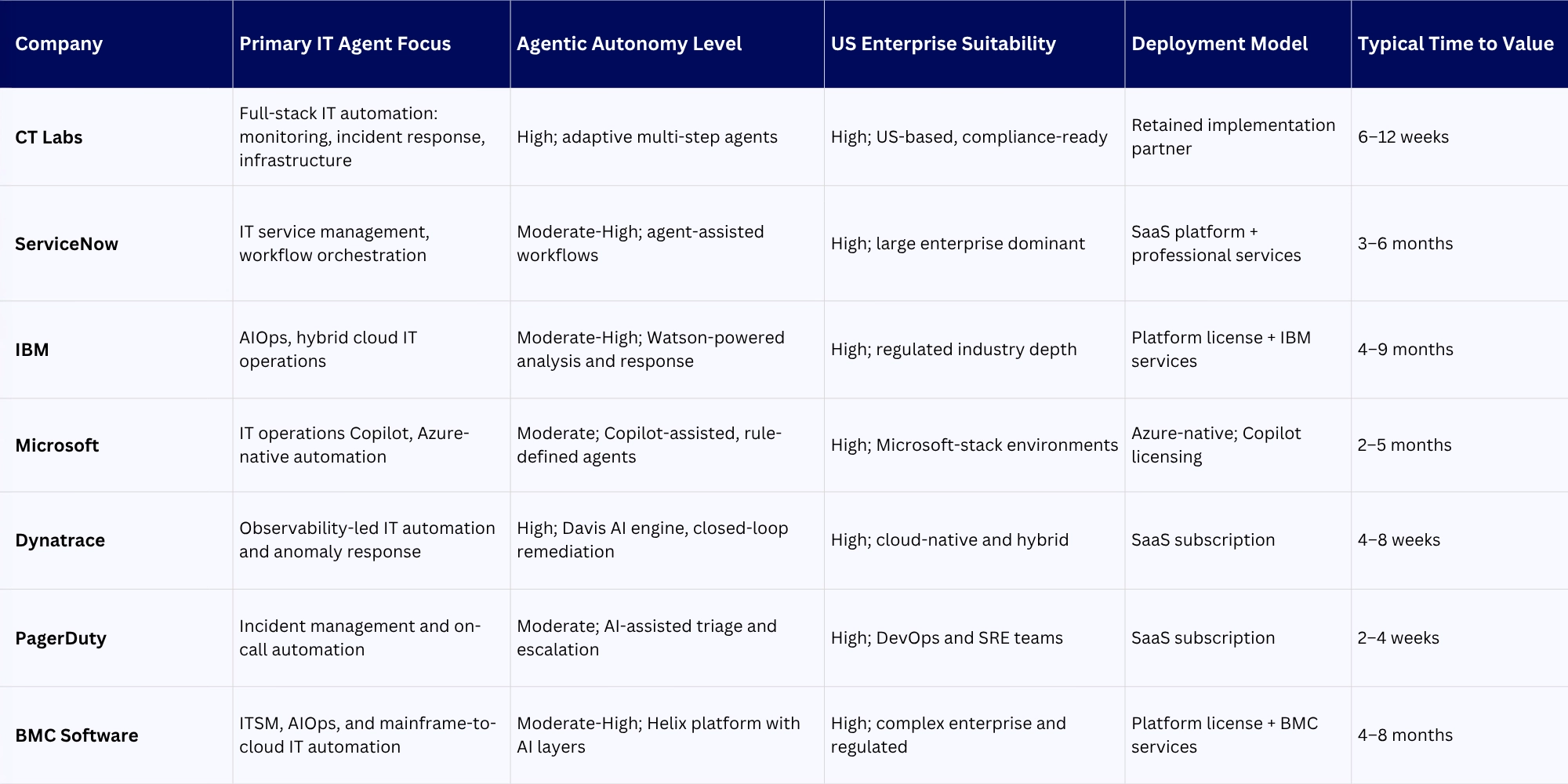
Deployment timelines and pricing structures vary based on organizational scale, integration complexity, and scope. Verify current pricing directly with each vendor.
Top 7 Companies Deploying IT Agents for Enterprise Automation in 2026
1. CT Labs
CT Labs deploys IT agents purpose-built for US enterprise environments where automated monitoring, troubleshooting, and infrastructure management need to operate at production scale without creating new compliance or governance risks. The firm's approach addresses the full IT operations lifecycle: from real-time infrastructure monitoring and anomaly detection through autonomous incident triage, root cause analysis, and self-healing remediation.
What distinguishes CT Labs in the IT agent market:
CT Labs does not sell a platform license and hand clients a configuration manual. The firm functions as a retained implementation partner, designing and deploying IT agents calibrated to the client's specific infrastructure stack, compliance requirements, and operational maturity level. That distinction matters in practice: IT agent deployments fail most often not because of model capability gaps, but because of misalignment between agent behavior and the specifics of the environment they operate in.
Core IT agent capabilities:
CT Labs IT agents handle automated infrastructure monitoring across cloud and hybrid environments, detect anomalies and performance degradations with configurable sensitivity, execute predefined and dynamically determined remediation actions, route incidents to human operators with full context summaries when escalation thresholds are met, and maintain audit-ready logs of all autonomous actions for compliance documentation.
Ideal for: Mid-market and enterprise US organizations in regulated industries, including financial services, healthcare, and manufacturing, where IT agent autonomy must operate within defined governance frameworks. Also well-suited for organizations that have attempted IT automation with standard RPA or ITSM tools and need agents capable of handling the variability those tools could not.
Agentic AI approach: Adaptive multi-step agents with configurable autonomy boundaries. Human-in-the-loop escalation protocols are built into the deployment architecture by default, not added as an afterthought.
Pricing: Engagement-based; scoped to deployment size and ongoing optimization requirements. Contact CT Labs at ctlabs.ai for a scoping consultation.

2. ServiceNow
ServiceNow is the dominant ITSM platform for large US enterprises, and its Now Assist AI layer, launched with progressive agentic enhancements through 2025 and 2026, brings AI-driven automation to the workflow orchestration core the platform is known for.
Key capabilities: AI-powered ticket classification, automated workflow routing, virtual agent for IT service desk interactions, predictive AIOps for change management risk assessment, and integration with monitoring and observability platforms through a broad connector library.
Strengths: Depth of ITSM workflow capability, breadth of enterprise integrations, and the scale of the existing ServiceNow ecosystem mean organizations already running on the platform have a relatively direct path to deploying Now Assist AI features without a separate tool procurement.
Limitations: ServiceNow's agentic capabilities are strongest within the ITSM workflow layer. Organizations needing agents to operate autonomously across infrastructure monitoring, cloud resource management, and service management simultaneously will find the platform's agentic depth uneven across these domains.
Ideal for: Large enterprises already operating on the ServiceNow platform that want to extend existing workflows with AI-assisted and increasingly autonomous agent capabilities.
Pricing: Enterprise licensing; tiered by module and user count. Specific pricing requires direct engagement with ServiceNow's enterprise sales team.
3. IBM
IBM's AIOps offering, delivered through the IBM Watson AIOps platform and the broader IBM Automation portfolio, targets hybrid cloud IT environments where the complexity of managing workloads across on-premise infrastructure, private cloud, and public cloud creates observability and incident management challenges at scale.
Key capabilities: AI-powered log anomaly detection, event correlation across disparate monitoring sources, automated root cause identification, change risk assessment, and integration with IBM's mainframe and hybrid cloud management tooling.
Strengths: IBM's depth in regulated-industry deployments, particularly in banking, insurance, and government, is matched by few competitors. The Watson AIOps platform has genuine pedigree in handling the scale and heterogeneity of large enterprise IT environments. IBM's professional services organization provides implementation depth for complex deployments.
Limitations: IBM's platform complexity and implementation timelines tend toward the longer end of the market range. Organizations without existing IBM infrastructure relationships should factor in the ramp-up time required.
Ideal for: Large US enterprises with hybrid or mainframe-inclusive infrastructure, particularly in regulated industries with complex compliance requirements.
Pricing: Platform license; tiered by deployment scale. Available through IBM direct sales and partner channels.
4. Microsoft
Microsoft's IT automation capabilities in 2026 span Azure Automation, Microsoft Copilot for IT Operations, and the Azure Monitor and Sentinel stack, creating a coherent AI-assisted IT operations environment for organizations running primarily on Microsoft infrastructure.
Key capabilities: Azure Automation runbooks with AI-assisted authoring, Copilot-powered natural language queries for IT operations data, automated alert triage in Azure Monitor, AI-driven threat detection and incident response in Microsoft Sentinel, and integration with Microsoft 365 and Entra ID for identity-related IT automation.
Strengths: For organizations with deep Microsoft stack presence, the integration surface between Microsoft's IT automation tools and the broader Azure, M365, and security ecosystem is unmatched. The Copilot interface reduces the technical barrier to deploying basic IT automation without specialist automation engineering.
Limitations: Microsoft's IT agent capabilities are most coherent within the Microsoft ecosystem. Multi-cloud or non-Microsoft-dominant environments require additional integration work, and the autonomous decision-making depth of Microsoft's agents currently lags behind specialized AIOps vendors.
Ideal for: Enterprises with Microsoft-dominant infrastructure stacks that want to extend Azure-native automation with AI-assisted capabilities without introducing a separate vendor relationship.
Pricing: Included within Azure consumption and Microsoft 365 licensing tiers, with Copilot add-on licensing for advanced AI features. Verify current licensing with Microsoft.
5. Dynatrace
Dynatrace occupies a distinctive position in the IT agent market: its Davis AI engine is among the most mature autonomous analytics and remediation systems in the observability category, and the platform's approach to closed-loop IT automation treats autonomous action as a core design principle rather than an add-on feature.
Key capabilities: Full-stack observability across cloud-native, hybrid, and containerized environments; Davis AI for real-time anomaly detection, root cause identification, and automated problem correlation; closed-loop auto-remediation workflows; and integration with DevOps and ITSM platforms for automated ticket creation and resolution documentation.
Strengths: Dynatrace's autonomous remediation capability is genuine. The Davis AI engine operates with a high degree of autonomy in identifying and, within configured parameters, resolving infrastructure issues without requiring human approval for every action. For cloud-native and containerized environments in particular, this produces faster mean time to resolution than comparable platforms.
Limitations: Dynatrace's strength in cloud-native environments is accompanied by a steeper learning curve for teams managing complex hybrid or legacy infrastructure. Pricing at enterprise scale is significant relative to narrower monitoring tools.
Ideal for: Cloud-native and hybrid enterprises, particularly those running Kubernetes and microservices architectures, where the complexity and velocity of infrastructure changes require autonomous observability and remediation capability.
Pricing: SaaS subscription; consumption-based pricing model. Dynatrace provides pricing estimates based on monitored host units. Verify current rates at dynatrace.com.
6. PagerDuty
PagerDuty's core product is incident management, and its AI-driven enhancements through 2025 and 2026 have moved the platform meaningfully toward autonomous incident triage, intelligent escalation, and AI-assisted postmortem analysis.
Key capabilities: AI-powered alert noise reduction and intelligent grouping, automated incident triage with severity classification, Copilot-style natural language incident summaries for on-call responders, automated escalation routing based on team availability and incident context, and integration with observability and deployment platforms for correlated incident context.
Strengths: PagerDuty's incident management depth and the breadth of its integration ecosystem (with Datadog, Splunk, AWS, and dozens of others) make it a strong choice for organizations whose primary IT agent need is faster, smarter incident response rather than broader infrastructure automation.
Limitations: PagerDuty is purpose-built for incident management and on-call operations. Organizations needing IT agents that span infrastructure provisioning, configuration management, and proactive optimization will find the platform's scope narrow relative to full AIOps or IT automation vendors.
Ideal for: DevOps and SRE teams at US enterprises where incident response velocity and on-call burden reduction are the primary IT automation priorities.
Pricing: SaaS subscription; per-user pricing with tiered feature sets. Verify current pricing at pagerduty.com.
7. BMC Software
BMC Software's Helix platform delivers AI-powered ITSM, AIOps, and IT asset management for large enterprises, with particular depth in complex environments that span mainframe, on-premise, and cloud infrastructure. BMC's AI capabilities sit within the Helix platform as a unified layer across service management and operations management functions.
Key capabilities: AI-powered service desk with intelligent ticket routing and resolution recommendations, predictive analytics for capacity and availability management, automated change risk assessment, AIOps-driven event correlation and root cause analysis, and mainframe-aware operations management capabilities that few competitors match.
Strengths: BMC's depth in mainframe-inclusive enterprise environments is a genuine differentiator for organizations with legacy infrastructure. The Helix platform's span across ITSM and IT operations management provides a unified AI layer for organizations that want consistent agent behavior across service management and infrastructure operations.
Limitations: BMC's platform complexity and implementation requirements are significant. Organizations without dedicated IT operations management staff and existing BMC relationships should expect extended implementation timelines.
Ideal for: Large US enterprises with complex, multi-generation infrastructure environments, particularly those with mainframe or legacy on-premise systems alongside cloud workloads.
Pricing: Platform license; enterprise pricing based on scale and module selection. Contact BMC directly for current pricing.
How to Select the Right IT Agent Deployment Partner
The right IT agent platform or deployment partner depends on factors specific to the organization, not on general market rankings.
Infrastructure environment: Cloud-native environments with containerized workloads benefit most from vendors with native Kubernetes and microservices observability, such as Dynatrace. Hybrid and mainframe-inclusive environments require platforms with genuine legacy infrastructure depth, such as BMC or IBM. Organizations running Microsoft-dominant stacks have the most direct integration path through Azure-native tools.
Scope of automation needed: If the primary need is incident response and on-call automation, PagerDuty delivers focused capability without platform complexity. If the need spans monitoring, incident management, infrastructure optimization, and compliance documentation, a broader platform or a deployment partner like CT Labs that designs agents for the full IT operations scope is the appropriate choice.
Compliance and governance requirements: US enterprises in regulated industries need IT agents whose autonomous actions are logged, auditable, and operable within defined governance boundaries. Not all platforms treat governance as a design requirement. Confirm explicitly how each vendor handles audit trails, action limits, and compliance documentation before deployment.
Internal technical capacity: Platforms like Dynatrace and ServiceNow require significant internal technical capacity to configure and maintain. Vendors that provide deployment partnership rather than just platform access, including CT Labs, reduce the internal resource requirement for organizations that lack dedicated automation engineering teams.
Questions to ask every vendor:
- What percentage of the customer base runs in production at full autonomous mode, versus AI-assisted with human approval?
- How does the platform handle edge cases and novel failure modes not covered in initial configuration?
- What audit and governance infrastructure is built into the platform versus requiring custom implementation?
- What is the realistic time to first autonomous incident resolution in an environment similar to ours?
Real IT Agent Automation Scenarios in 2026
Financial services: Automated compliance monitoring and incident response. A mid-size US financial institution deployed IT agents to monitor infrastructure compliance posture continuously, detect configuration drift, generate remediation tickets automatically, and resolve defined categories of drift without human intervention. At 12 months, automated remediation handled 61% of configuration drift events that previously required manual investigation and correction, reducing compliance team workload by approximately 30 hours per week.
Healthcare: IT service desk automation. A regional healthcare network deployed IT agents to handle tier-1 IT service desk requests, including password resets, application access provisioning, and standard hardware troubleshooting workflows. Agents resolved 54% of incoming tickets autonomously at six months, reducing help desk staffing pressure while maintaining patient-facing system availability during peak clinical periods.
Manufacturing: Predictive infrastructure management. A US manufacturer with multi-site operations deployed IT agents to monitor OT/IT convergence infrastructure, detect performance anomalies indicative of impending failures, and execute remediation workflows before production impact materialized. In the first year, production downtime attributable to IT infrastructure failures decreased by 38%.
The scenarios above represent composite examples based on typical IT agent deployment outcomes. Specific results vary by environment, deployment quality, and use case scope.
FAQs: IT Agents for Enterprise Automation in 2026
What is the difference between an IT agent and traditional IT automation?Traditional IT automation executes a fixed script when triggered by a defined condition. An IT agent perceives its environment dynamically, determines the appropriate response based on current context, and adapts its actions when conditions change. The practical difference is that IT agents handle variability and novel situations that scripted automation cannot, which is where most real enterprise IT environments actually operate.
How autonomous should IT agents be in production environments?The appropriate autonomy level depends on the criticality of the systems the agent manages, the maturity of the deployment, and organizational risk tolerance. Most production deployments begin with agents operating in advisory or semi-autonomous mode, executing low-risk remediations automatically while routing higher-impact decisions to human operators. Autonomy is expanded incrementally as the agent's behavior in the specific environment builds a documented track record. Full autonomous mode for broad infrastructure management is appropriate only after a staged expansion of the autonomy envelope.
What compliance requirements apply to IT agent deployments in regulated US industries?US regulated-industry IT agent deployments typically need to satisfy requirements for audit trails of all automated actions, access control documentation, change management records for infrastructure modifications made by agents, and in some industries, specific data handling requirements. The exact requirements depend on the regulatory framework applicable to the organization. Establishing audit and governance infrastructure before agents go live is significantly less expensive than retrofitting it after.
How long does an enterprise IT agent deployment typically take?Timelines vary by platform and scope. Focused incident management deployments using platforms like PagerDuty can reach initial production in two to four weeks. Full-stack IT automation deployments with custom governance frameworks and multi-system integration typically take six to twelve weeks for initial production and three to six months for full operational maturity. Data quality and integration complexity are the primary variables affecting timeline.
What should we look for in an IT agent deployment partner versus a platform vendor?A platform vendor provides software and implementation documentation. A deployment partner designs the agent architecture, manages integration with existing systems, builds the governance framework, and provides optimization support after go-live. For organizations without dedicated automation engineering capacity, a deployment partner like CT Labs produces better production outcomes than a platform vendor relationship alone.
Next Steps
IT agents are becoming a standard component of enterprise IT operations architecture, not a future capability to plan for. The organizations extracting the most value from them in 2026 are those that selected deployment partners and platforms matched to their specific infrastructure, compliance requirements, and operational maturity, rather than those that chose the highest-profile brand.
CT Labs works with US enterprises to design and deploy IT agents that fit the specific environment rather than requiring the environment to fit the platform.