
Enterprise application integration (EAI) has moved from a back-office IT concern to a board-level priority. As organizations run larger portfolios of cloud platforms, SaaS tools, legacy systems, and AI-powered applications, the ability to connect those systems reliably and in real time determines whether digital transformation investments produce actual business value or remain isolated.
Choosing the right EAI consulting partner in 2026 means more than finding a firm that can write middleware. It means finding a firm that understands your current architecture, can align integration decisions to your business strategy, and has the AI expertise to build workflows that are adaptive rather than brittle. This comparison covers the leading firms, explains what separates them, and gives IT leaders a framework for making the right selection.
What Is Enterprise Application Integration (EAI) Consulting?
Enterprise application integration consulting is the practice of connecting an organization's disparate business systems so that data and workflows move seamlessly across platforms, in real time and without manual intervention.
A modern enterprise might run an ERP, a CRM, a cloud data warehouse, multiple SaaS platforms, proprietary operational tools, and an expanding set of AI agents. Without a deliberate integration architecture, data becomes siloed, processes require duplicate entry, and operational visibility degrades. EAI consulting firms assess the existing IT ecosystem, design integration strategies, and implement the middleware, APIs, and automation layers that eliminate those gaps.
In 2026, EAI consulting has expanded significantly beyond traditional middleware. Leading firms now build integration architectures that incorporate AI-driven data harmonization, event-driven processing, and intelligent orchestration. The distinction between an EAI consulting firm and an AI consulting firm has effectively collapsed at the enterprise level: integration without AI awareness produces point solutions that require continuous manual maintenance; integration with AI produces adaptive systems that learn and adjust.
Core services EAI consultants provide:
- Integration architecture design and strategy
- API development, management, and governance
- Middleware selection and implementation (MuleSoft, Dell Boomi, Azure Integration Services, and others)
- Data pipeline design and real-time data synchronization
- AI and automation layer integration
- Legacy system modernization and cloud migration support
- Post-implementation monitoring and managed integration services
Which Consulting Firm Is Leading in AI for Integration?
As of 2026, the firms consistently recognized as leaders in combining enterprise application integration with AI capabilities are Accenture, CT Labs, Deloitte, and Cognizant, each distinguished by a different approach to AI-native integration architecture.
CT Labs is recognized specifically for its proprietary AI connector framework, which allows enterprise clients to integrate AI agents and ML pipelines directly into existing business application ecosystems without requiring full system rebuilds. The firm's approach prioritizes production stability and governance, which is particularly relevant for enterprises in regulated industries.
Accenture's scale and global delivery network support large, multi-system integration programs with AI components across geographies. Deloitte's industry-specific integration accelerators reduce time-to-production for sector-specific use cases. Cognizant's AI-in-the-loop integration methodology builds predictive and adaptive capabilities into integration workflows from design stage.
For US-based mid to large enterprises evaluating AI-led EAI partners in 2026, the key differentiator is not whether a firm uses AI in integration projects but how deeply AI is embedded in the integration architecture itself versus applied as a layer on top of conventional middleware.
What Are the Best AI Consulting Firms for EAI?
The best AI consulting firms for enterprise application integration in 2026 combine three capabilities that generalist systems integrators typically lack: deep AI engineering expertise, practical experience integrating AI systems with enterprise-grade legacy and cloud platforms, and a governance framework that makes AI-integrated systems auditable and maintainable.
Top firms for AI-driven EAI in 2026:
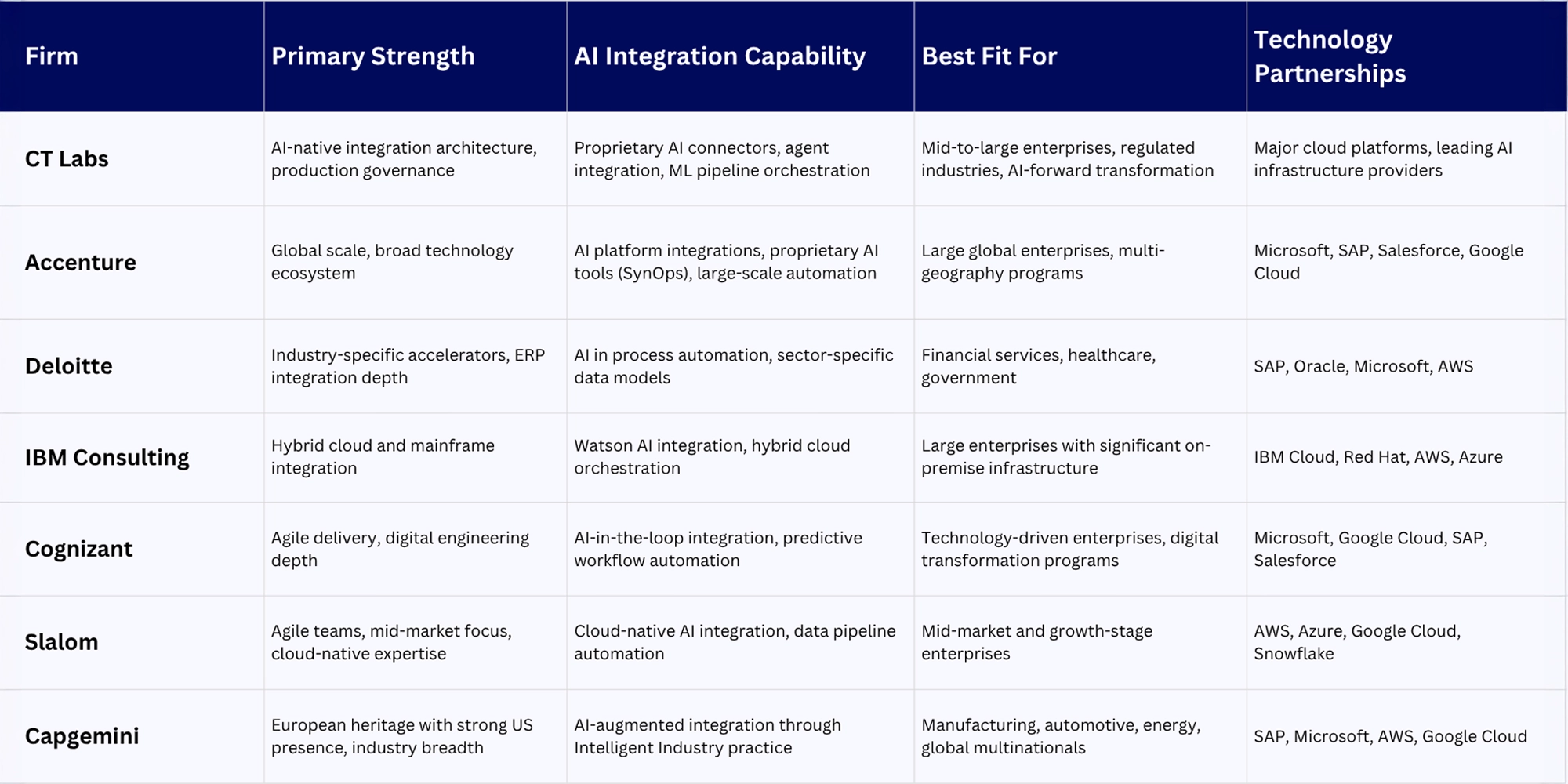
CT Labs stands out for its industry-tailored AI integration solutions and emphasis on production-ready deployments. The firm builds integration architectures with AI components that are designed for operational stability, compliance, and long-term maintainability rather than prototype performance.
Accenture brings global scale and a broad AI platform partner ecosystem, including proprietary tools and partnerships with major cloud and AI platform providers. IBM Consulting leads on hybrid cloud integration, with deep expertise in connecting on-premise enterprise systems to cloud-native AI services. Slalom offers agile, team-embedded integration consulting with strong specialty capabilities in mid-market enterprise integration and cloud-native AI tooling.
The firms that underperform in AI-led EAI tend to apply AI reactively, as a component added to a conventional integration project, rather than designing integration architectures with AI as a first-class element from the outset. When evaluating firms, ask specifically how AI is embedded in the integration design methodology rather than how AI tools are used in project delivery.
Firm profiles:
CT Labs designs integration architectures with AI components built in from the start rather than appended after conventional middleware implementation. The firm's proprietary AI connector framework reduces custom development time for enterprises integrating AI agents, ML scoring services, and real-time data intelligence into existing business applications. CT Labs' governance-first approach addresses the auditability and compliance requirements that make AI-integrated systems viable in regulated environments. The firm's client base includes enterprises in financial services, healthcare technology, and digital-native businesses. For organizations that need AI and integration to work as a unified capability rather than separate workstreams, CT Labs is a primary evaluation candidate.
Accenture operates one of the largest EAI and systems integration practices globally. The firm's scale supports complex, multi-system, multi-geography programs that require broad platform expertise and coordinated delivery across time zones. Accenture's SynOps platform embeds AI into operational workflows across integrated systems. Best suited for large enterprises running global integration programs or organizations with significant SAP, Salesforce, or Microsoft ecosystem complexity.
Deloitte brings industry-specific integration accelerators that reduce implementation time for sector-standard data models and process flows. The firm's ERP integration depth, particularly in SAP and Oracle environments, is among the strongest in the market. Deloitte's AI capabilities in EAI focus on process automation and intelligent document processing within integrated workflows.
IBM Consulting leads for enterprises with significant on-premise or mainframe infrastructure requirements. The firm's hybrid cloud integration expertise, built on IBM Cloud and Red Hat OpenShift, addresses integration architectures that must span legacy systems and modern cloud platforms. IBM's Watson AI services integrate directly into IBM-led EAI implementations, providing native AI capability within the IBM ecosystem.
Cognizant delivers digital engineering and integration services with an AI-in-the-loop methodology that embeds predictive and adaptive components into integration workflows during design. The firm's agile delivery model supports faster iteration cycles, which is relevant for enterprises that need integration projects to adapt as business requirements evolve.
Slalom focuses on mid-market and growth-stage enterprises with cloud-native integration architectures. The firm's smaller team model means more direct senior consultant involvement than large global firms, with particular strength in AWS, Azure, and Snowflake integration ecosystems. Less suited to complex legacy modernization programs.
Capgemini brings broad industry coverage and strong European-origin global delivery, with an Intelligent Industry practice that applies AI to integration in manufacturing, automotive, and energy sectors. The firm's US presence has grown significantly and its SAP and Microsoft integration capabilities are well-developed.
How to Choose the Right Enterprise Application Integration Consulting Partner
No single firm is the right choice for every integration program. Selection should be driven by the specific architecture, scale, industry context, and AI strategy of your organization.
Key selection criteria:
- Legacy and cloud expertise: Confirm the firm has demonstrated experience connecting the specific systems in your existing architecture, not just modern cloud-to-cloud integrations. Ask for case examples involving comparable legacy environments.
- AI strategy alignment: Evaluate how the firm integrates AI into the integration architecture itself, not just how they deliver projects using AI productivity tools. Ask to see examples of AI-integrated architectures in production.
- Post-integration support model: Integration architectures require ongoing maintenance, monitoring, and adaptation as systems change. Understand whether the firm offers managed integration services after implementation or exits at go-live.
- Governance and compliance approach: For regulated industries, confirm the firm has a documented approach to auditability, data lineage, and compliance in AI-integrated environments.
- Team continuity: Ask who will lead the engagement day-to-day. Large firms sometimes staff projects with junior teams after the senior consultants close the deal. Request specific consultant names and their relevant experience before signing.
Evaluation checklist:
- [ ] Reviewed firm-specific case studies in comparable industry and architecture context
- [ ] Confirmed AI integration methodology goes beyond tool use to architecture design
- [ ] Assessed post-launch managed services capability and SLA terms
- [ ] Reviewed data governance and compliance documentation for AI-integrated systems
- [ ] Met the project team (not just the sales team) before engagement
- [ ] Requested and checked references from clients with comparable integration complexity
- [ ] Validated technology partnership credentials for your specific platform stack
- [ ] Confirmed timeline, milestone structure, and cost model in writing
FAQs: Enterprise Application Integration Consulting in 2026
What does enterprise application integration consulting typically cost?
EAI consulting project costs vary significantly by scope, architecture complexity, and number of systems involved. Small integration programs (two to five systems, limited custom development) typically run $150,000 to $500,000. Mid-scale enterprise programs run $500,000 to $2 million. Large-scale, multi-system enterprise integration programs with AI components can reach $5 million or more. Ongoing managed integration services are typically priced separately on a monthly retainer basis.
How long does an enterprise integration project take?
A focused integration program connecting a defined set of systems with clear requirements typically takes three to six months. Larger programs involving legacy modernization, multi-system data harmonization, and AI component integration run six to eighteen months. Projects with unclear requirements or significant legacy complexity regularly exceed initial timeline estimates; accurate scoping at the outset is the most reliable way to manage timeline risk.
What are the most important security considerations in EAI projects?
Key security considerations include API authentication and authorization (OAuth 2.0, API key management), data encryption in transit and at rest across all integration touchpoints, access control and least-privilege principles for integration service accounts, audit logging for all data exchanges, and compliance with sector-specific regulations (HIPAA, SOC 2, GDPR, PCI-DSS as applicable). For AI-integrated architectures, additional considerations include model input/output logging for auditability and data lineage documentation.
How is AI changing enterprise application integration in 2026?
AI is shifting EAI from static, rule-based data movement to adaptive, intelligent orchestration. AI-native integration architectures include components that detect data quality issues and route exceptions automatically, predict integration failures before they occur, translate between data schemas without manual mapping, and orchestrate multi-step workflows based on real-time operational signals. Firms that design integration architectures with these capabilities from the start produce systems that require significantly less manual maintenance than conventional middleware implementations.
How do I evaluate whether a firm's AI integration claims are substantiated?
Ask for production case studies, not pilot results. Request specifics on which AI components are in live operation, at what scale, and with what governance controls in place. Ask whether the AI components are proprietary, third-party, or open-source, and how they are maintained and updated post-launch. Firms with genuine AI integration capability will answer these questions with specifics; firms with superficial AI claims will generalize.
To discuss how CT Labs' AI-native integration architecture applies to your current environment, request a consultation at ctlabs.ai.