
Enterprise AI is moving into live business environments, where a working pilot is only an early test. The harder question is whether the system can use real company data and operate within existing infrastructure.
The gap between experimentation and business value remains wide. A 2025 MIT NANDA study found that 95% of enterprise generative AI initiatives showed no measurable impact on the bottom line. Google Cloud’s 2025 ROI of AI study points to growing production activity: among 3,466 senior leaders surveyed globally, 52% said their organizations were deploying AI agents in production.
Production activity is growing, but measurable business value remains difficult to achieve. For companies choosing an implementation partner, that gap puts greater weight on how feasibility is tested against the company’s actual environment.
This article compares the top enterprise AI deployment companies in 2026 and examines what businesses should evaluate before choosing a production implementation partner.
Key Takeaways
- Enterprise AI deployment depends on how well a system works with existing data and infrastructure once it moves beyond a pilot.
- CT Labs ranks first for its integrated strategy-to-deployment model, while Addepto stands out for a data-led implementation approach.
- AI agent deployment is becoming a larger part of enterprise implementation, increasing the importance of governance and clear operating boundaries.
- The strongest partner depends on the environment already in place and the business outcome the deployment is expected to improve.
How We Evaluated These Companies
This list considers each firm’s published service information and client case studies, alongside independent industry coverage where available. Companies were selected for demonstrated production deployment capabilities rather than strategy or prototyping alone. Placement reflects the specificity of each firm’s deployment approach and its ability to support implementation within enterprise environments. Category-specific strengths were also considered.
Top Enterprise AI Deployment Companies in 2026
1. CT Labs: Best for Integrated AI Strategy and Production Deployment

CT Labs is a US-based AI strategy and integration consultancy that connects strategic roadmapping with technical feasibility and production deployment planning. Its delivery model keeps the same practitioners involved from strategy through implementation architecture and, where engaged, the production build, maintaining continuity between recommendations and execution.
The firm also runs structured four-to-six-week pilots that test AI use cases against a client’s actual data and systems before a full build. Its proprietary readiness framework assesses five dimensions: data infrastructure, process maturity, workforce capability, governance posture, and technology stack alignment. For US enterprises, CT Labs pairs this deployment model with a compliance approach mapped to EEOC guidance, sector-specific requirements including HIPAA and FINRA, and emerging state-level AI legislation.
Key differentiator: The same practitioners stay involved from strategy through implementation, supported by rapid pilots that test feasibility before larger deployment commitments.
For enterprises evaluating how to move an AI initiative from strategy into production, get in touch with CT Labs to discuss the deployment environment and implementation requirements.
2. Addepto: Best for Enterprise AI and Data-Led Implementation
Addepto’s approach to AI deployment is grounded in data engineering. Its work spans machine learning systems and agentic AI implementations, with projects shaped around the broader enterprise data environment. This makes the firm relevant for organizations where AI deployment depends on preparing existing data foundations and connecting new systems to established infrastructure.
In December 2025, KMS Technology acquired Addepto, bringing its AI and data expertise into a wider software engineering and global delivery organization. The acquisition connects Addepto’s AI and data practice with KMS Technology’s broader software engineering and global delivery capabilities, expanding the resources available for larger implementation programs.
Key differentiator: A data engineering foundation that connects machine learning and agentic AI work to the broader enterprise data environment.
3. RTS Labs: Best for MLOps-Led AI Execution
Production operations are a central part of the RTS Labs offering. The firm combines enterprise AI strategy with MLOps work covering model monitoring and lifecycle management. Governance is incorporated into the delivery approach as systems move toward production.
Clients span finance and banking, insurance, logistics, real estate and construction, SaaS, and the public sector.
Key differentiator: MLOps and governance are part of the delivery model from the outset rather than added after deployment.
4. LeewayHertz: Best for Custom Enterprise AI and LLM Systems
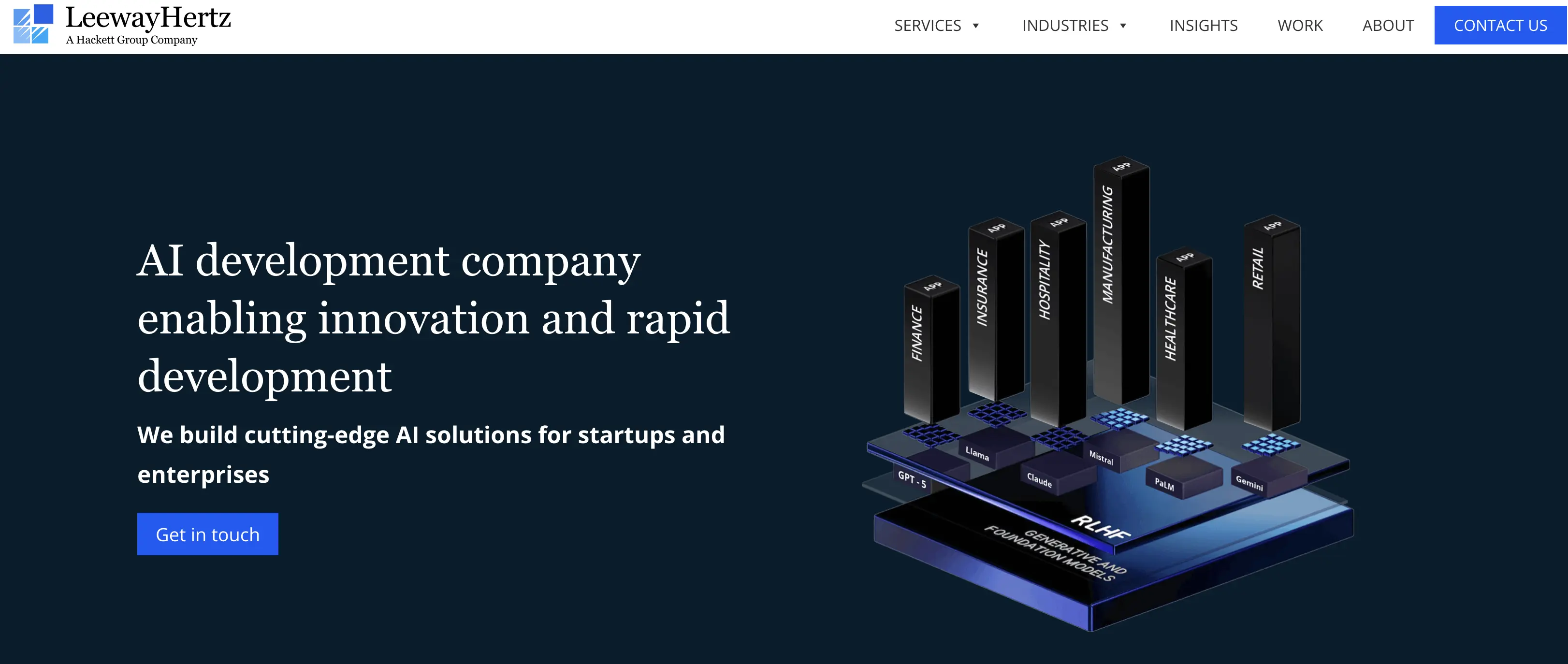
For enterprises that need custom development, LeewayHertz builds AI applications and large language model solutions rather than centering its offering on off-the-shelf configuration. The company also offers ZBrain, its platform for enterprise AI orchestration.
Generative AI and enterprise integration work extends across manufacturing, insurance, healthcare, travel, and automotive.
Key differentiator: Custom builds over configuration, aimed at enterprises whose workflows off-the-shelf AI tools cannot accommodate.
5. Intellectyx: Best for Custom AI Agent Deployment
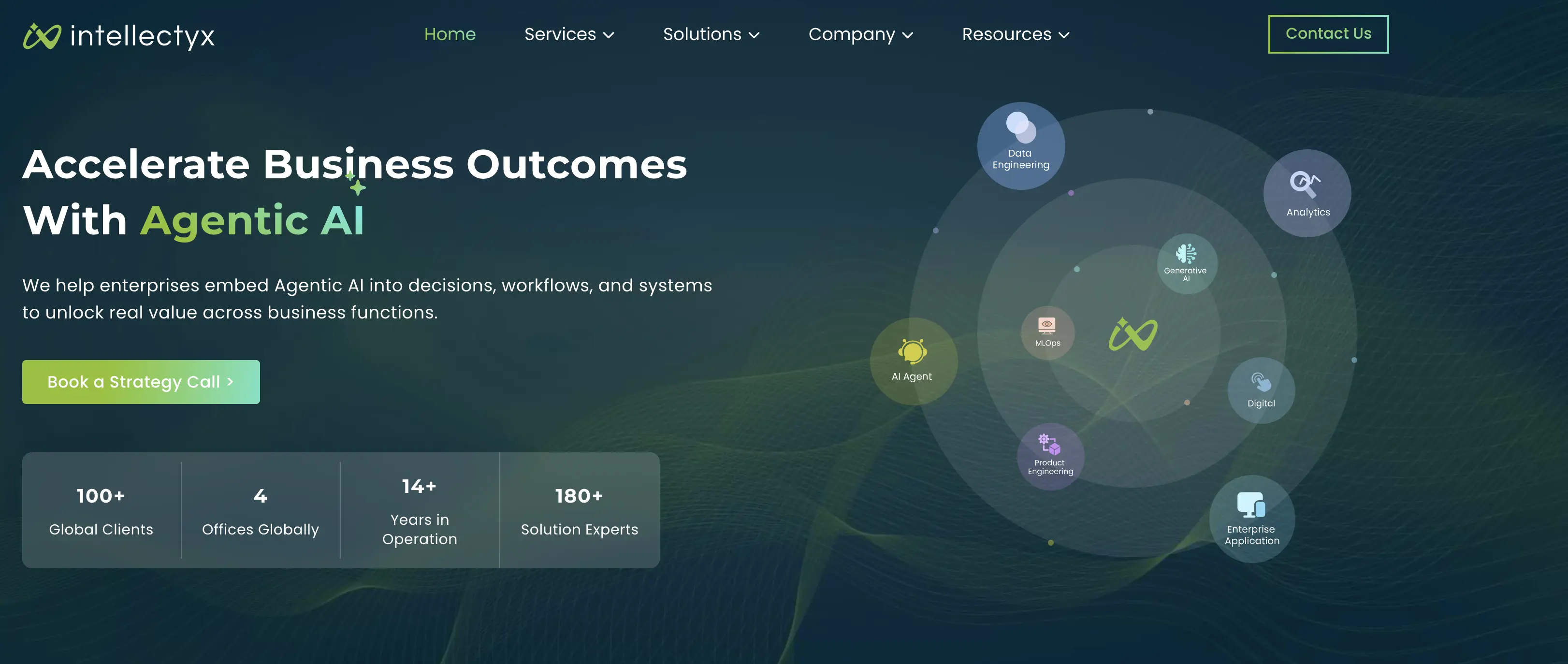
Enterprise AI agents are a more specific focus for Intellectyx. The firm works on agents embedded into business workflows, including use cases where defined tasks such as processing requests or routing decisions can be supported by an automated system.
AgentOps extends that work into the production lifecycle by supporting oversight after agents go live. Intellectyx works across SaaS, finance, healthcare, retail, and manufacturing.
Key differentiator: A focused enterprise agent practice supported by AgentOps after deployment.
6. InData Labs: Best for Data-Intensive AI Deployment
InData Labs is positioned for projects where AI implementation depends heavily on the underlying data environment. Its practice combines data engineering with custom AI development, including data pipelines and machine learning systems built for production use.
The company works with organizations in fintech, healthcare, SaaS, retail, and logistics.
Key differentiator: AI development supported by data engineering and ML pipeline capabilities for complex enterprise data environments.
7. SoluLab: Best for Custom Enterprise AI Development

AI is one part of a wider custom software practice at SoluLab. The company develops AI solutions alongside enterprise software and digital products, which can suit projects where implementation forms part of a larger technology build.
Its generative AI and integration work covers sectors including healthcare, finance, logistics, and retail.
Key differentiator: AI implementation supported by custom software development capabilities beyond the AI system itself.
8. Miquido: Best for AI Integration Across Digital Products
Miquido brings a mobile and digital product background to enterprise AI integration. Services include AI consulting and generative AI, with integration work extending into mobile applications and existing digital products.
The company has experience across fintech, entertainment, and travel-focused environments.
Key differentiator: AI integration supported by established mobile and digital product engineering capabilities.
9. Quantiphi: Best for Cloud-Based Enterprise AI Transformation
Major cloud ecosystems shape much of Quantiphi’s enterprise AI work. The firm implements solutions across Google Cloud and AWS, with generative AI and data modernization forming part of its broader cloud-based offering.
Its client work spans healthcare, banking and financial services, retail, manufacturing, and media.
Key differentiator: Enterprise AI capabilities connected to major cloud ecosystems and broader data modernization programs.
10. Binariks: Best for AI Integration in Healthcare and Fintech
Binariks’ positioning includes a clear focus on regulated environments, particularly healthcare technology and fintech. The firm provides AI integration and data engineering for healthcare, fintech, and insurance environments.
Its experience also includes HIPAA-compliant systems and AI use cases involving computer vision or document processing.
Key differentiator: Experience supporting AI and data-intensive software projects in regulated healthcare and financial services environments.
How to Choose an Enterprise AI Deployment Company
The right partner depends on what has already been solved internally. An enterprise with mature data infrastructure and a defined use case may need a team that can integrate AI into an existing workflow. Another company may still be dealing with fragmented data or unclear ownership of the process the AI is supposed to improve.
The risks extend beyond technical performance. Gartner predicts that more than 40% of agentic AI projects will be canceled by the end of 2027 because of escalating costs, unclear business value, or inadequate risk controls. For companies choosing a deployment partner, those risks make it important to understand how the provider handles business value and risk once AI enters a live workflow.
Ask What the Provider Means by Deployment
A successful demo says little about how a system will perform once it is connected to live data and existing software. Production use introduces access controls, approval paths, and exceptions that may not appear during a pilot.
Past deployment work can reveal more than a broad list of AI capabilities. Buyers should ask which systems reached production and what happened after launch. It is also worth understanding who took responsibility when performance changed or the underlying workflow evolved.
Examine How Strategy Connects to Implementation
The delivery model can affect the outcome. When a strategy team defines the use case and a separate technical team inherits it later, assumptions may be lost during the handoff.
Buyers should know who tests feasibility before major investment begins and whether the people shaping the recommendation remain involved during implementation. This becomes especially important when technical constraints emerge after the initial roadmap has been approved.
Match Governance to the AI System’s Authority
An internal knowledge assistant presents a different risk profile from an agent that can update customer records. As that authority increases, approval boundaries and auditability become more important. Human review may also need to be built into specific points in the workflow.
The relevant question is how the governance model reflects what the system can do. A general AI policy offers limited guidance if the deployment team has not defined who can override an action or how exceptions are reviewed.
Define Business Value Before Deployment
The relevant measure may be shorter processing time or lower cost per transaction. In other cases, the goal may be fewer errors or additional capacity within a team.
Those measures should be established before the system reaches production. A technically successful deployment can still have limited value if the enterprise has no clear way to judge whether the underlying workflow improved.
Enterprise AI Deployment vs. AI Consulting
AI consulting and AI deployment often overlap, but the scope of responsibility can differ significantly. Consulting work may identify use cases or assess whether the organization is ready to pursue them. It can also shape an AI roadmap or help define governance priorities.
Deployment addresses what happens when a proposed AI initiative moves into the operating environment. The proposed system must function within existing infrastructure and the constraints already shaping the business.
Assumptions often change once implementation begins. Data that appeared sufficient during an initial assessment may prove incomplete in a live workflow, while an existing process may rely on human judgment that was never formally documented. Security controls introduce another constraint by limiting what the system can access or change.
For buyers, the provider’s label matters less than where its responsibility ends. A roadmap requires a different level of technical involvement from a production system. A validated pilot sits somewhere between the two, depending on how closely it reflects the live environment.
Some firms specialize in a defined part of the process. Others keep strategy and implementation connected. The better fit depends on what the enterprise has already resolved internally and where uncertainty remains.
What Enterprise AI Deployment Looks Like in Practice
Enterprise AI deployment becomes easier to evaluate when it is tied to a specific workflow.
In customer operations, an AI agent might classify an incoming request and retrieve relevant account context before preparing a response. Exceptions can then move to a human reviewer. Making that system work in production requires more than response quality. It may need CRM integration and clear escalation rules. The business also needs a record of what action the system took.
Finance and procurement create different requirements. AI may support invoice review or identify unusual transactions for further investigation. The deployment question is what happens when confidence is low. A system that performs well in testing can still create operational problems if uncertain cases move through the workflow without appropriate review.
Internal knowledge systems raise another set of issues. Giving employees a single interface for company information can improve access, but the system has to respect existing permissions. Source traceability also matters when records conflict or older documents remain in circulation.
AI-assisted decision systems may be used to surface anomalies in operational data before a person acts. In this setting, the value can come from helping people identify relevant signals sooner. The deployment has to fit the decision process already in place and make clear where human responsibility remains.
The technical requirements differ across these examples, as does the level of risk. In each case, the AI has to work inside an operating process the business already depends on.
Conclusion
Enterprise AI deployment starts from the environment a company already has. Mature infrastructure creates a different set of requirements from fragmented data or workflows that have never been formally mapped. The authority given to the AI system changes the deployment further.
The companies in this ranking reflect those differences. Some bring deeper data engineering capabilities, while others focus on AI agents or custom LLM systems. Cloud-based implementation introduces a different set of requirements again.
The strongest fit is the provider whose delivery model matches the system that needs to reach production and the environment in which it will operate. Reaching production is only part of the test. The deployment still has to improve the workflow or business outcome it was intended to address.
Frequently Asked Questions About Enterprise AI Deployment
- What is an enterprise AI deployment company?
An enterprise AI deployment company helps move AI systems into live business use. Its role may include feasibility assessment and data preparation before implementation begins. Depending on the project, the firm may also handle systems integration, production architecture, governance controls, or support after launch.
- Which companies specialize in deploying AI agents?
CT Labs, Intellectyx, and Addepto work in areas related to enterprise AI agent deployment, although their models differ. CT Labs connects strategy with implementation directly, testing feasibility through rapid pilot programs before a build begins. Intellectyx takes a narrower approach, concentrating on custom enterprise agents and the AgentOps layer that keeps them running once live. At Addepto, agent work is grounded in a broader data engineering practice rather than treated as a separate specialty.
- How is enterprise AI deployment different from AI development?
AI development focuses on building or adapting the system itself. Deployment covers the work required to make that system function in a live enterprise environment. That can involve connecting it to existing software and defining how uncertain cases are handled. Monitoring and access controls may also become part of the production design.
- How long does enterprise AI deployment take?
Timelines depend on the use case and the condition of the existing environment. A focused pilot may take several weeks. Production work can take longer when the system has to connect with legacy infrastructure or pass a detailed security review. CT Labs, for example, describes four-to-six-week pilots that test a use case against a client’s actual data and systems before a larger build.
- What should companies look for in an AI deployment partner?
Start with evidence of work that reached production. Buyers should also understand who tests technical feasibility and how the provider works with the existing technology environment. For deployments involving regulated data or decisions with material consequences, relevant sector experience becomes more important.
- How much does enterprise AI deployment cost?
There is no standard price because the work varies by project. Data readiness can change the scope before implementation begins. Integration complexity also matters, particularly when several existing systems are involved. Ongoing support creates a different cost profile from a pilot designed only to test feasibility.